The former CEO of ASML, the company that makes the machines that make the chips that run the modern world, had one core message: Europe has everything it needs to compete at the highest level. The talent. The capital. The technology. The know-how.
And it is squandering all of it.
He called it, a few years back, being “fat, dumb, and happy.” Not complacent. Not overly self-confident. Fat, dumb, and happy. Those softer words let you off the hook. They don’t capture the sting of knowing there’s a problem, having every means to fix it, and choosing not to.
That diagnosis hasn’t changed. What’s changed is the price of ignoring it.
A society that can no longer afford itself
Before getting to manufacturing, Wennink made a point most industry talks don’t bother with: a business cannot thrive inside a society that is falling apart.
His version of a responsible society rests on four pillars: jobs that pay enough to live on, education accessible to every child, care for those who need it, and security, physical, digital, and climate-related. Remove any one of them and the rest start to wobble.
This isn’t idealism. It’s economics. Employees perform better when they’re not worried about whether their kids can go to school or whether their parents can get into a hospital. That stability is the foundation. Manufacturing doesn’t float above society. It sits inside it.
The problem is that foundation is cracking. Maintaining it costs more every year. Productivity growth isn’t keeping pace. In the Netherlands, GDP growth is projected at under 1% annually for the next decade. Wennink’s number: you need at least 2% to fund the kind of society that makes business worth doing. Europe is tracking at half that. The math is not complicated, and it is not forgiving.
And while Europe is drifting, the world’s largest economies are racing. Four massive societal transitions are reshaping every major economy at once: digitization and AI, life sciences, energy and climate, and security and resilience. China’s five-year plan is structured around them. The United States’ investment agenda is built around them. When Wennink returns from Beijing, Delhi, or Washington, the pattern is always the same: faster movement, bigger bets, clearer intent.
Europe, meanwhile, is sitting on world-class capabilities in every single one of those domains and watching the window close.
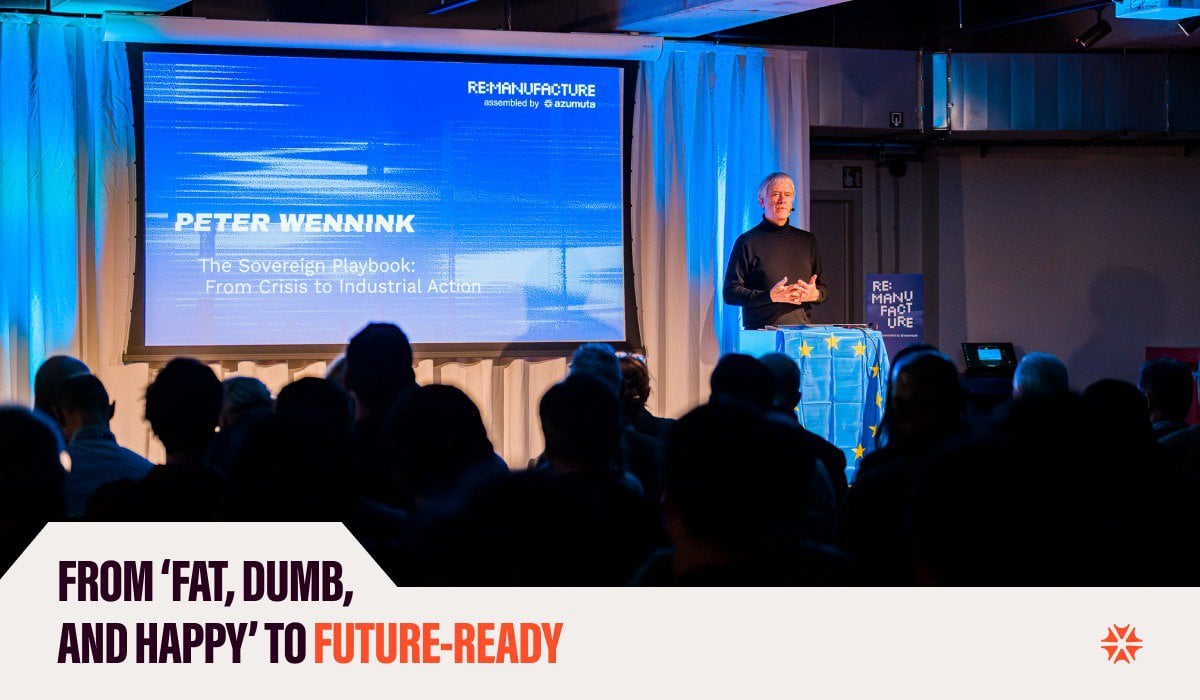
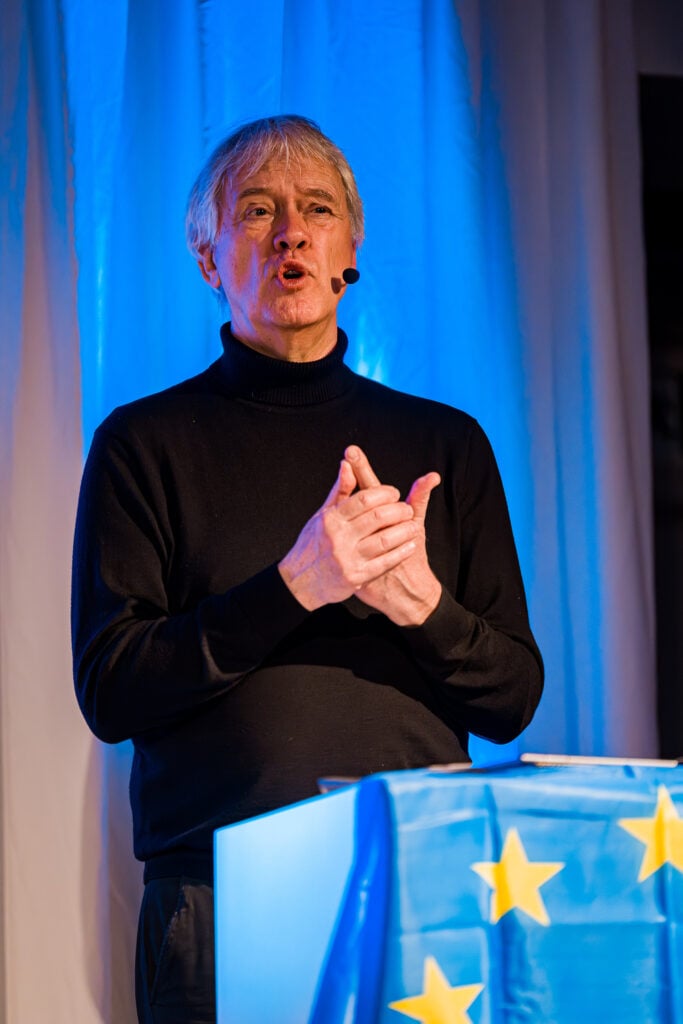 Peter Wennink on stage at Re:Manufacture 2026
 Four self-inflicted reasons Europe is stuck
Wennink doesn’t deal in abstractions. He sees four specific conditions blocking Europe’s potential. Each one entirely fixable. None of them fixed.
Infrastructure. Today, 95% of Europe’s compute activity runs through data centers outside Europe. Ninety-five percent. If that access were cut tomorrow, nothing works. Not a theoretical vulnerability. A real one, hiding in plain sight, that everyone has agreed to ignore. Beyond digital infrastructure, more than 14,000 businesses in the Netherlands alone are waiting for an electricity connection. Grid congestion is not a future problem. It is stopping investment today.
Talent. Three failures in one. Europe isn’t producing enough STEM graduates. It faces a re-skilling crisis as AI eliminates entire categories of professional work, not manual jobs, but economists, mathematicians, analysts at major financial institutions. And it is failing to attract the global talent it desperately needs, because the political conversation around migration has made talent mobility collateral damage in a culture war. The domestic talent pool is not big enough. Everyone knows it. Nothing changes.
Regulation. The EU’s state aid rules were designed to stop governments from endlessly propping up dying industrial giants. A reasonable purpose. The rules are now being applied to innovative startups that are cash-poor by definition and embryonic by design. Lawyers are classifying them as “enterprises in difficulties” and blocking public support. A rule built to prevent the past from being preserved is now preventing the future from being built. That is not an edge case. That is the system working exactly as misconfigured.
Capital. The Netherlands alone holds 2.5 trillion euros in pension savings and bank deposits. Most of it is parked outside Europe, chasing the market median, which is predominantly US and Asian assets. Meanwhile, a chip startup that needs 300 million euros to tape out its first working prototype has to go to the United States to find investors who understand the business. Europe’s money is funding everyone else’s future.
The proof of concept: ASML showed Europe what’s possible
Wennink didn’t arrive at these conclusions from a think tank. He arrived at them from the shop floor of the most strategically critical company in the global semiconductor supply chain.
ASML makes the lithography machines that are required to manufacture every advanced chip on the planet. There is no alternative supplier. That position wasn’t handed to ASML. It was built, over thirty years, through a model that Europe has largely forgotten how to replicate.
The model is what Wennink calls the triple helix: government, business, and knowledge institutions working seamlessly together. Not in committees. Not in consultation rounds. Together, with shared goals, shared risk, and shared reward. Brainport Eindhoven is the physical embodiment of that model. ASML is its most visible product. A system integrator standing on the shoulders of 4,000 suppliers and partners, most of them European, many of them built in direct collaboration with universities, research labs, and technical schools.
That collaboration worked because it was built on trust and transparency. Every partner knew what was at stake. Every partner had something real to lose. And every partner had something real to gain.
When the Dutch Minister of Economic Affairs asked Wennink to write a report on what Europe should do, Wennink said yes. Not because he believed he had all the answers, but because he knew how to assemble the people who did. He organised thirty-one round tables, each one mixing startups, scale-ups, multinationals, universities, and public institutions, each one focused on one of the four strategic domains. The brief was simple: give me a moonshot that can actually happen, an investment case, a timeline, a funding split, and the reason it hasn’t happened yet.
The last question was the most revealing. Every group had ideas. The ideas were good. The reason they hadn’t happened was always the same: the boundary conditions weren’t met.
“The willingness, the creativity, the power is there. But the boundary conditions are not met. And that is a political decision.”
What came back from those thirty-one tables was €126 billion in identified investment potential across the four domains. Ready to move the moment the conditions are right.
That number is not a projection. It’s a pipeline. Built by the people who would actually execute it, if someone would get out of the way.
The fix: build the conditions, then get out of the way
Here is where Wennink’s argument shifts from diagnosis to prescription. And it is more concrete than most people expect from a keynote.
The starting point is the triple helix, applied at scale. Not just in Eindhoven. Across the continent. The delta region connecting Belgium, the Netherlands, and Germany is an economic powerhouse in waiting. Belgian biotech is world-class. Dutch semiconductor expertise is among the best on the planet. German engineering anchors the entire supply chain. These competencies don’t need to be created. They need to be connected.
But connection requires conditions. And Wennink is specific about what those conditions look like.
On infrastructure: Europe needs to build its own compute capacity, urgently. It needs to resolve grid congestion not by managing demand, but by accelerating supply. Physical and digital infrastructure should be treated as strategic assets, not administrative problems.
On talent: make STEM education free. Give technical universities priority on student housing. Build a national re-skilling agenda before the first wave of AI-driven layoffs forces the issue. And separate the conversation about economic migration from the one about talent migration. They are not the same thing.
On regulation: strip the state aid rules back to their original purpose. Stop applying enterprise survival logic to embryonic innovation. Simplify permitting. The nitrogen lock, Byzantine approval processes, and layers of gold-plated EU regulation are not protecting anyone. They are running the clock down on Europe’s window.
On capital: Wennink’s proposal, now written into the Dutch coalition agreement, is a national investment bank. Independent, professionally governed, insulated from political interference, but funded by the state. With a working capital of €10 to 20 billion, the bank could mobilise up to €100 billion in total investment by co-financing alongside pension funds and private equity. The logic is simple: institutional investors won’t take first-loss risk alone. If government takes that first layer, the rest follows. A second institution, a National Agency for Breakthrough Innovation, with a €2 billion budget, would sit alongside it, funding the innovation ecosystems and strategic projects that the market won’t touch alone.
“The biggest issue of AI is not compute power. It’s energy. And I think we in Europe have the technical capabilities to create AI chips which can compete with Nvidia — and which are perhaps even a hundred times more energy efficient.”
That opportunity is sitting on the shelf. What it needs is capital patient enough to fund the first chip, infrastructure capable of running it, talent skilled enough to build it, and regulation smart enough not to block it.
This is a political choice
The capability gap is not a market failure. The talent problem is not an accident. The regulatory mess is not inevitable. These are the result of political choices, made over years, by people who understood the tradeoffs and prioritized something else. And if they are political choices, they can be changed.
Wennink is clear on what that change requires. Economic policy needs to become a matter of European priority, with the Prime Minister accountable for future earning power, not just the Minister of Economic Affairs. The Minister of Economic Affairs needs to regain control over energy and trade policy. An independent Commissioner for Future Prosperity should sit above departmental silos, run the national investment council, and have the legal mandate and a dedicated fund to break deadlocks and accelerate delivery.
The report’s word for what’s gone wrong is precise: procesfetisjisme. Process fetishism. The machinery of government has started running for its own sake, and the people inside it have stopped asking whether any of it is actually working. Permitting that takes years. Rules that serve no one. Accountability structures that reward caution over results. What’s required isn’t another strategy paper. Wennink’s report identifies a clear direction, and the Dutch coalition agreement already incorporates its core proposals, including the national investment bank. What’s required is the political courage to follow through. The willingness to deregulate not because it’s ideologically convenient, but because the alternative is decline. The willingness to fund infrastructure not in response to a crisis, but in anticipation of one.
“Not acting is also a choice. Every day we don’t invest in the future of our country, the bill for future generations grows. We don’t need to figure this out anymore. Let’s begin.”
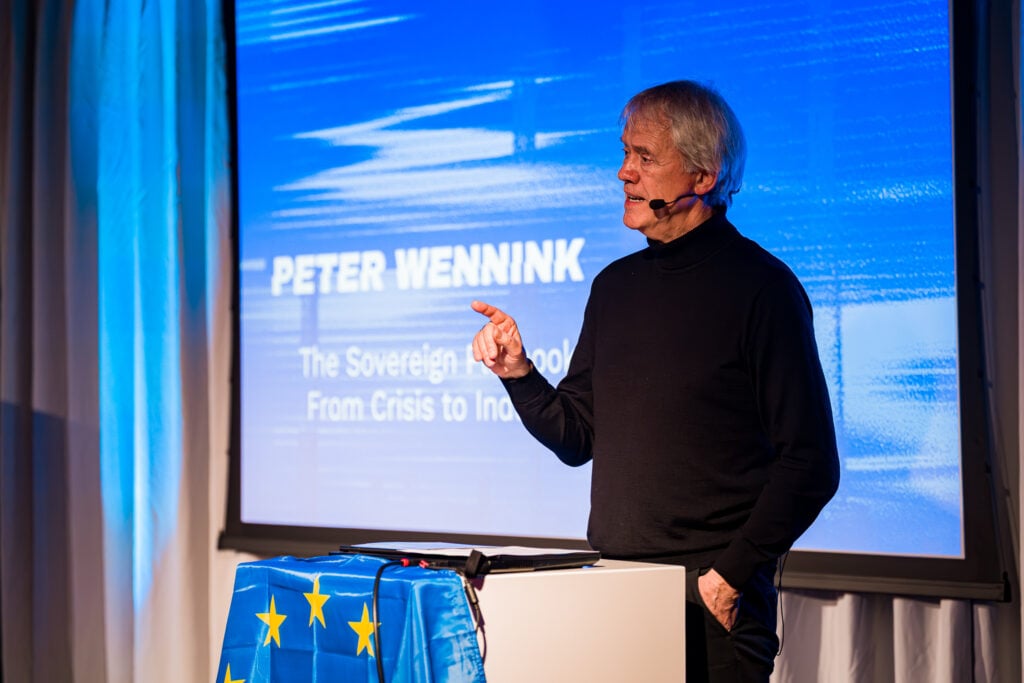 Peter Wennink on stage at Re:Manufacture 2026
 Europe isn’t lost yet.
Wennink closed his keynote with a lesson from his early days at ASML. He walked in as an accountant. Someone told him that under pressure, everything becomes fluid. He pushed back on the physics. The engineers corrected him: it’s not just pressure. It’s the right pressure.
Europe is under the right pressure right now. Geopolitical shocks. Supply chain fragility. Leaders elsewhere making it explicitly clear that no one is coming to help. A world that no longer takes European relevance as a given.
That is not a threat. That is the best catalyst Europe has had in decades. And squandering it would be the most expensive mistake this continent has ever made.
The knowledge is here. The capital is here. The talent is here. The technology is here. And the domains where Europe can win are not abstract. They are specific: digitization and AI, life sciences, energy and climate, security and resilience. Four domains where global demand is exploding, where Europe has genuine competencies, and where falling behind is not just an economic problem. It is a geopolitical one. ASML proved that European collaboration, when it is serious, can produce something the entire world depends on. Brainport proved that the triple helix is not a theory. It is a repeatable model. Thirty-one round tables proved that €126 billion in investment is sitting ready, not in some future budget, but in the hands of people who are willing to deploy it today. If someone fixes the conditions.
That someone is government. Not the market. Not industry. Government. The people with the mandate, the instruments, and, frankly, the responsibility to act. Stop gold-plating regulation. Fix the grid. Fund the infrastructure. Build the national investment bank. Make STEM education free. Protect talent migration. And then step aside and let European industry do what it has always been capable of doing when the conditions are right.
Europe doesn’t need to dominate every domain. It doesn’t need strategic autonomy, a phrase Wennink explicitly rejects. It needs to be relevant. It needs a seat at the table.
The seat is available. The question is whether European leaders have the courage to take it. Because the alternative isn’t managed decline. It’s irrelevance. And irrelevance, once it sets in, is very hard to reverse.