From ‘fat, dumb, and happy’ to future-ready: Peter Wennink’s playbook for European manufacturing sovereignty

Europe doesn’t need another slogan. It needs execution.
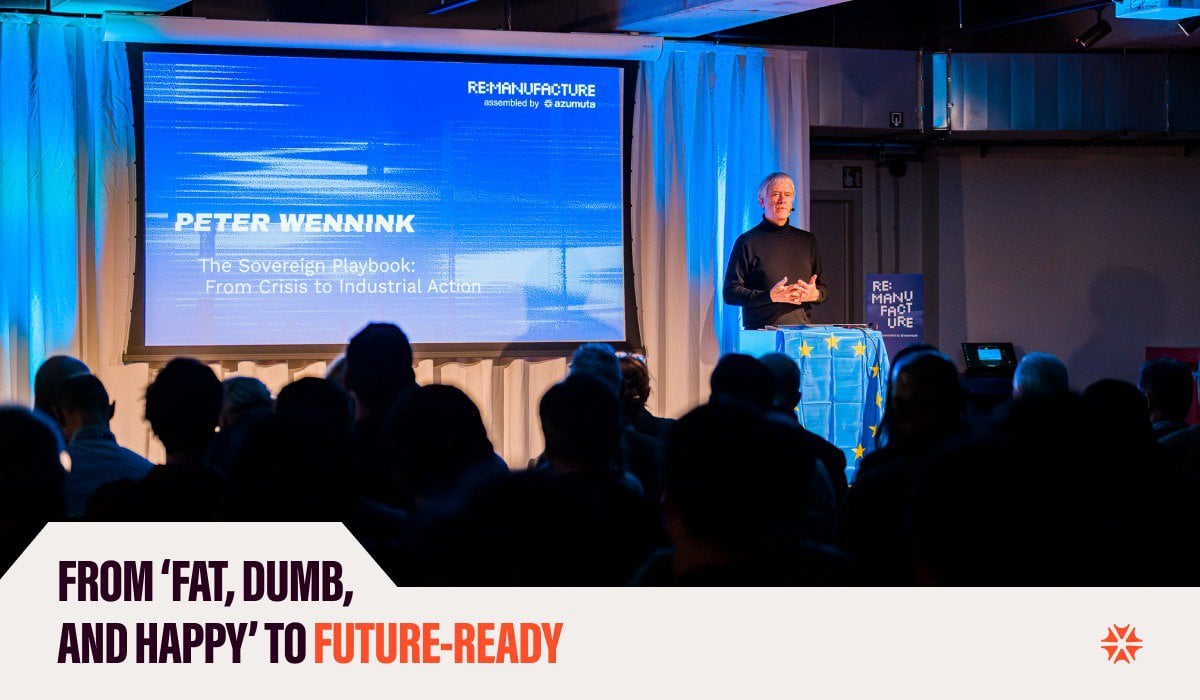
Peter Wennink speaking at a conference about European manufacturing sovereignty, showcasing Azumuta's digital solutions for Industry 4.0 and smart manufacturing.
Published on:
02 April 2026
Updated on:
02 April 2026
In his keynote at Azumuta’s Re:Manufacture event, Peter Wennink (former CEO of ASML) put it bluntly: Europe has been “fat, dumb, and happy” not because it lacks capability, but because it hasn’t been acting with urgency.
His message wasn’t pessimistic. It was operational: Europe can win if it builds the conditions for innovation and industrial scale. For manufacturers, that’s the whole game.

The core idea: don’t aim for “autonomy”

Wennink challenged the term “strategic autonomy.” Total independence isn’t realistic (or even desirable) in a global economy. The goal is to be relevant, to have a “seat at the table.”
“If you don’t have a seat at the table, you’re probably on the menu.”


For manufacturing leaders, the translation is simple:
  • If your plant can’t meet new quality, compliance, and delivery expectations, you’ll be treated as interchangeable.
  • If you can standardize execution, prove compliance, and scale know-how across sites, you become a partner the ecosystem depends on.
That is why frontline execution matters. 

Four global transitions where Europe must compete

Wennink framed today’s competitive landscape around four transitions happening everywhere:
  • Digital and AI (including semiconductors, compute, quantum, and industrial software)
  • Life sciences and biotech (driven by demographics)
  • Energy and climate (driven by resilience and cost)
  • Security (physical, digital, and economic)
Manufacturing sits underneath all four. If Europe wants to lead in these transitions, it needs factories that can execute reliably, at speed, and improve continuously.

The ASML lesson: collaboration wins when trust is operational

ASML’s success story is also a manufacturing story: a system integrator standing on the shoulders of thousands of suppliers and partners.
The key mechanism wasn’t hype. It was a collaboration model based on:
  • Transparency between partners
  • Fair risk and reward sharing
  • A single shared objective
That is exactly how modern manufacturing networks work: multi-tier supply chains, shared standards, shared evidence, shared problem-solving.
The practical question is: can your organization run that way across shifts, lines, and sites?

The “boundary conditions” Europe must fix (and what it means on the shop floor)

Wennink’s most actionable contribution is his framework of four boundary conditions. These aren’t abstract policy debates. They determine whether manufacturing innovation actually scales.

1) Infrastructure: physical and digital

Infrastructure isn’t just roads and ports. It’s digital infrastructure and compute capacity. If your ability to run critical systems depends on capacity outside your control, you’re vulnerable.
On the shop floor, infrastructure shows up as:
  • Real-time access to the “single source of truth” for procedures
  • Reliable connectivity across lines and sites
  • Data you can trust because it’s captured at the moment of work
This is why digitizing execution can’t stop at dashboards. It has to reach operators.
If you’re standardizing work, start with digital work instructions that are usable on the line, not written for binders.

2) Talent: educate, reskill, and enable mobility

Wennink highlighted three talent levers:
  • Educate more STEM talent
  • Reskill at massive scale (AI will shift jobs, not only “low-skilled” work)
  • Support talent migration thoughtfully
Manufacturing leaders can’t wait for national policy to catch up. The fastest lever is time-to-competency.
Two practical moves:
  • Replace tribal knowledge with structured learning
  • Make training visible and measurable
A strong skills strategy isn’t “HR admin.” It’s capacity insurance. If you’re exploring this, start with a clear view of skills and gaps using a skills matrix approach.

3) Regulation: simplify without lowering the bar

Wennink’s critique isn’t “regulation is bad.” It’s that complexity and “gold plating” can block innovation, especially for startups and new industrial initiatives.
For manufacturers, the parallel is clear: compliance requirements aren’t going away. But compliance work can be simplified.
That means:
  • Standardized procedures
  • Consistent evidence capture
  • Audit-ready reporting without heroics
It is also why many teams revisit the basics: what belongs in an SOP vs. what belongs in a work instruction. If you’re aligning documentation, see SOP vs work instruction.

4) Access to capital: fund innovation across the readiness levels

Wennink gave a concrete example: building a single advanced chip can cost hundreds of millions before scaling. Europe has capital, but it often isn’t mobilized for risk.
For manufacturing organizations, “access to capital” shows up as a different bottleneck: the ability to prove ROI quickly.
That is where execution-layer investments win. When you can tie digital standard work to measurable outcomes, like less scrap, fewer deviations, and faster onboarding, you reduce perceived risk.
If you need internal proof points, start with practical use cases like AI in manufacturing that connect directly to quality and productivity.

Why this matters right now: productivity funds the society we want

A responsible society needs jobs, education, care, and security. Wennink’s warning is that these systems cost money, and productivity growth is falling behind.
Manufacturing productivity isn’t a macroeconomics footnote. It is the engine that funds everything else.
But productivity doesn’t come from “working harder.” It comes from reducing friction:
  • Fewer errors and rework
  • Faster changeovers and training
  • Better first-time-right execution
  • Closed-loop continuous improvement
That is why frontline execution is strategic.

A practical takeaway for plant leaders: become relevant by mastering execution

If Europe’s goal is relevance, manufacturing’s goal is the same.
Relevance is earned when you can:
  • Launch new products and variants without chaos
  • Prove compliance without panic
  • Scale best practices across sites
  • Onboard and reskill workers quickly
One simple starting point is shrinking the gap between “what we say we do” and “what we actually do.” Lightweight formats like one-point lessons help teams standardize critical know-how without slowing operators down.

And if you’re still relying on paper-based instructions, it’s worth revisiting the foundational question: why work instructions matter.

Re:Manufacture exists to bring manufacturers, operators, and technology leaders together around one shared objective: make industry more resilient, more competitive, and more human.

Peter Wennink’s keynote fits that mission because it refuses to separate policy ambition from operational reality.

“Relevance” is not something you declare. It is something you build. And in manufacturing, you build it through execution. Clear standards, fast learning, reliable proof, and continuous improvement.

If you want to go deeper into the broader work behind the Sovereign Playbook, you can explore Peter Wennink’s report site here: rapportwennink.nl
Join The Digital Shop Floor Revolution!

A profile of an assembly operator is displayed on the left side, showing categories such as Pre-Assembly, Assembly, and Testing. Adjacent charts detail tasks like Cleaning, Assembly, Packaging, Pre-Assembly, and Testing, each with numerical values.