Once known mainly as on-premise control systems to ensure compliance and track production, MES has evolved into a key operational priority. Global cost pressures, supply chain volatility, and higher quality expectations have raised the profile of MES as a backbone of digital manufacturing. What’s particularly interesting is how this change is happening. It is driven by the needs of the workforce and the rapid advances in technology from the top. The next generation of MES will emerge at this intersection.
This article builds on insights from Azumuta’s MES: The Next Chapter report, based on in-depth interviews with experts from across the manufacturing and technology ecosystem. The report brings together perspectives from Jim Mayer, Eric Kimberling, Andy Lievens, Rens Bonnez, Christophe Michiels, Juan Luis Sanchis Martínez, Robert Braund, Xavier Bourgois, and Batist Leman, reflecting viewpoints from companies such as Toyota, Delaware, Renson, and Sirris. Together, these conversations highlight how MES is evolving at the intersection of workforce needs and advancing digital technologies.
Their shared message is clear: the next wave of MES will not depend on the number of features a platform offers. Instead, it will rely on how well it links advanced technology with the people using it on the shop floor.
From Monolithic Systems to Flexible Ecosystems
MES is moving away from large, single platforms to more flexible and modular systems. Traditional systems often felt like huge control towers; they were powerful, but also rigid and hard to adjust. That model does keep up with today’s rhythm in manufacturing.
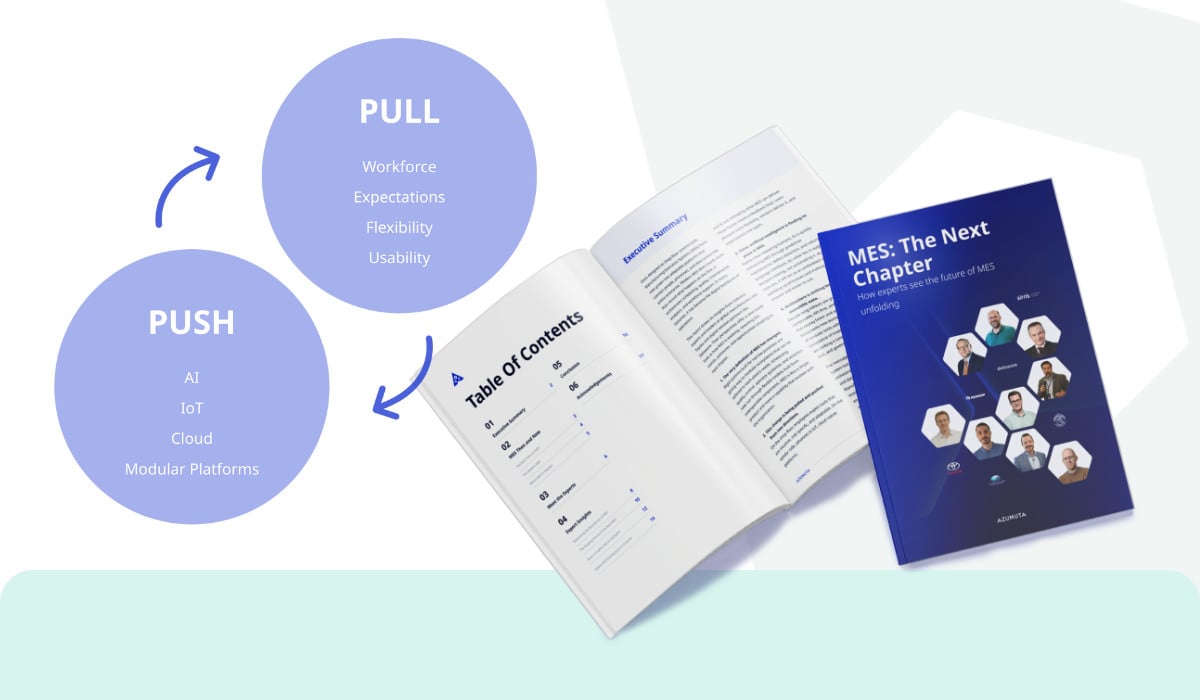
This shift is driven by two main factors:
- Bottom-up pull: Operators and plant teams want easy-to-use and adaptable tools that fit their work styles.
- Top-down push: Vendors are offering cloud services, IoT connectivity, AI, and analytics, pushing MES toward better capabilities.
The future will depend on how these factors affect one another. Let’s examine each side more closely.
Bottom-Up Pull: Workforce Expectations and Flexibility
In the coming years, a younger, digital-native generation will comprise the majority of the manufacturing workforce. They have grown up with modern interfaces and mobile-first tools. Their expectations also apply to MES. Surveys show that most link their job choices to a company’s technology level. Many want to use their smartphones at work. MES adoption now relies heavily on meeting those expectations.
Several dimensions define this bottom-up pull:
- User-friendly design
If an MES feels as outdated as an old terminal, adoption stalls. A clean UI, clear navigation, and mobile access are now basic requirements. As Jim Mayer points out, success hinges not just on features but on whether teams actually use them. Adoption is the true differentiator.
- Low-code and configurability
Manufacturers want the freedom to adapt their systems quickly. Low-code and no-code tools allow engineers and plant IT to modify forms, dashboards, or work instruction formats without waiting for a vendor. Batist Leman emphasizes that next-gen MES should empower “citizen developers” to make changes quickly and iteratively.
- Modularity and scalability
Factories increasingly prefer modular architectures over all-in-one systems filled with unused features. Modular MES allows organizations to start with what they need and expand over time. Xavier Bourgois explains that manufacturers want a system that “connects the dots” while adapting to their processes rather than forcing standardization.
- People and processes first
Beyond usability, the biggest motivation from the shop floor is human-centered functionality. Operators want real-time feedback, easy access to work instructions, and straightforward ways to adjust or update processes. This aligns with Deloitte’s findings that preparing workers for the “Factory of the Future” remains a top concern. When people feel supported, adoption rises and ROI improves.
The bottom-up pull can be summed up simply: the modern workforce wants an MES that is as agile and tech-friendly as they are. If a platform meets these expectations, employees will embrace it in their daily work and even advocate for it. If not, even the most impressive features might go unused. As one industry veteran remarked, “Not even the best MES can help if no one likes using it.”
Top-Down Push: Technology Innovation and Vendor Drive
In parallel, vendors are pushing a wave of innovation into the MES market. The speed of change in cloud, AI, IoT, and integrations is reshaping what MES is expected to deliver.
- Cloud and hybrid architectures
More than half of manufacturers already use cloud technologies, and MES is following suit. Cloud-native and SaaS MES platforms enable faster deployments, easier scaling, and remote access to production data. Many manufacturers choose hybrid setups to balance agility with local control, especially in regulated or connectivity-challenged environments.
- Industrial IoT (IIoT)
MES is becoming the central hub of connected production. With most manufacturers integrating IoT technologies, MES increasingly handles real-time machine data, cycle times, energy consumption, and more. This transforms MES from a passive system into an active participant that senses changes and supports decisions instantly. Xavier Bourgois notes that MES at Renson is evolving into a hub connecting PLCs, sensors, and building systems, a major shift from the isolated IT of the past.
- Artificial intelligence and analytics
AI is becoming a co-pilot in production environments. Vendors are embedding AI for intelligent scheduling, documentation retrieval, anomaly detection, and predictive quality. Experts agree that AI should assist, not replace, humans, offering guidance while operators and engineers make the final call. Features like predictive analytics or chat-based guidance are already making their way into leading MES platforms.
- Interoperability and integration
MES is increasingly expected to integrate seamlessly with ERP, PLM, SCM, IoT platforms, and other factory systems. Vendors are prioritizing open APIs and strong partnerships, ensuring MES fits into existing digital ecosystems rather than requiring major replacements. Interoperability enables a more cohesive flow of data, ultimately expanding MES value.
The top-down push aims to give manufacturers the advanced capabilities needed for competitiveness, but these technologies only matter if they make life easier for people on the factory floor.
Push Meets Pull: Finding the Sweet Spot
The next generation of MES will flourish where these forces intersect: powerful technology delivered through accessible, human-centered systems.
- People-First Design, Powered by Tech
A modern MES should blend intuitive design with smart support. A simple mobile UI, backed by AI insights, gives operators clarity while keeping them in control. AI identifies risks, suggests improvements, or retrieves information instantly, without removing autonomy.
- Flexible Architecture with Strong Functionality
Manufacturers want both agility and capability. A modular, low-code MES that easily integrates IoT data and cloud analytics provides just that: adaptability without sacrificing depth. Plants can grow at their own pace while accessing enterprise-wide insight.
- Continuous Improvement Loop
When MES is easy to use, the workforce engages more deeply. Better engagement means better data; better data leads to smarter insights; smarter insights enable targeted improvements. Low-code updates complete the loop quickly. This cycle becomes a strong driver of ongoing improvements.
- Adaptation to Change
With markets shifting, products changing, and skills evolving, MES must keep up. Hybrid cloud, modularity, and AI-guided insights allow manufacturers to adjust quickly, from remote reconfigurations to fast deployment of new instructions or checks. Flexibility becomes a strategic advantage.
The Next Chapter of MES
The forces shaping MES, the influence from the workforce and the drive from technology, are connected. A technology-focused MES that overlooks the user will not succeed; a user-friendly system that lacks modern features will limit possibilities. The future belongs to platforms that balance flexibility, smart features, and user-centered design.
The MES of tomorrow will serve as the connection point for digital manufacturing: modular, easy to use, and well integrated. It will use AI and IoT to provide real-time insights while being flexible enough for frontline teams to customize it as needed. It will grow as businesses expand, fit seamlessly with the existing ecosystem, and support ongoing improvements driven by its users.
For manufacturers looking at systems today, one message is clear: choose an MES that your people will accept, supported by technologies that help them thrive. The next era of MES will involve both factory teams and the innovators creating the tools, and the most effective systems will unite these elements.
Download the MES Report
9 MES experts on what’s to come for MES in the coming years. Read insights from Toyota, Delaware, Renson, and more.