
Reading ergonomic risk straight from shopfloor video
In brief
The same shopfloor recording that drives our work-instruction capture also carries the operator's posture. Here is how we turn it into metric 3D pose and defensible ergonomic risk scores, on-premise.
TL;DR
Problem
- Manual ergonomic assessment does not scale. RULA, REBA, and EAWS worksheets are filled in by hand from stopwatch-and-clipboard observation, so only a few workstations ever get assessed, and only once.
- The posture data that would justify a redesign is locked inside video nobody has time to score frame by frame.
Context
- The same overhead recording we already capture for work instructions contains the operator’s full-body posture. Recent 3D human-pose models can reconstruct that posture from a single camera.
- Ergonomic methods (RULA, REBA, EAWS) are, at their core, functions of joint angles and how long they are held. Metric 3D pose gives us exactly those inputs.
Solution
- We reconstruct metric 3D pose locally (no video leaves the site), derive joint angles, and score RULA, REBA, and EAWS along the run timeline.
- A person stays in the loop: the scores are a first draft to review and correct, not an automated verdict.
Problems
Assessment does not scale
Ergonomic risk on an assembly line is real and expensive, but the way it gets measured has barely changed. A trained assessor watches a task, times it, and fills in a RULA, REBA, or EAWS worksheet by hand. That is slow, it is subjective between assessors, and it only ever covers a handful of workstations. The workstations that are never assessed are not low risk, they are simply unobserved. And because an assessment is a one-off snapshot, it goes stale the moment the line is rebalanced or a fixture moves.
The data exists but is unusable
Many sites already record assembly for training or work-instruction purposes. That footage contains everything an assessor would look for: how far the operator reaches, how long a shoulder stays elevated, how often they bend. But turning hours of video into posture data by eye is exactly the manual effort that made assessment unscalable in the first place. The information is present and effectively unusable at the same time.
2D is not enough
The obvious shortcut, running a cheap 2D keypoint detector over the video, does not work for ergonomics. RULA and REBA are defined in terms of joint angles: trunk flexion, shoulder abduction, elbow angle. You cannot recover those reliably from 2D pixel coordinates, because the same 2D projection can correspond to very different real postures depending on how the body is turned relative to the camera. Ergonomic scoring needs true metric 3D, or the numbers are confidently wrong.
Context
From pixels to joint angles
A modern 3D human-pose model reconstructs the body in metric space from ordinary video. In our pipeline the recommended engine is a parametric model (ROMP) that regresses a full SMPL-style 24-bone rig directly from each frame, rather than detecting loose keypoints. Regressing the whole body at once keeps the skeleton anatomically consistent even under partial occlusion, which is the normal case on a real line where fixtures and the operator’s own body hide joints. The output is a true metric 3D joint set plus per-joint rotations, calibrated once per run and then temporally smoothed so the skeleton does not jitter frame to frame.
A second engine (MediaPipe BlazePose) is available as a faster, lighter alternative. Both emit metric 3D, which is the property ergonomic scoring actually depends on.
What RULA, REBA, and EAWS need
These three methods are standard ergonomic assessment tools. RULA (Rapid Upper Limb Assessment) and REBA (Rapid Entire Body Assessment) score posture from joint angles and load, flagging awkward positions of the trunk, neck, and limbs. EAWS (European Assembly Worksheet) is broader and widely used in automotive assembly. What they have in common is that they are computed from geometry and duration: which angles, how extreme, and for how long. Once we have a reliable 3D joint series, computing them stops being a manual worksheet and becomes a calculation we can run over an entire recording.
Solution
Risk over time, not a single snapshot
Instead of one score for a task, the pipeline produces a joint-risk-over-time track along the whole run. The timeline is divided into review segments at a granularity you choose, and each segment carries its RULA, REBA, or EAWS score. This turns a static worksheet into something closer to a monitor: you can see which phases of the cycle drive the risk, not just that the task as a whole scored poorly. That is the difference between “this station is a problem” and “the reach on step 4 is the problem.”
A human stays in the loop
Automatically derived scores are a starting point, not a ruling. The interface is built for correction: an assessor can scrub the timeline, inspect the reconstructed skeleton frame by frame, adjust keypoints where the model got a joint wrong, and re-score. The goal is to make an expert assessor dramatically faster and more consistent, while keeping the final judgement with a person. Audit-readiness matters here, so edits are tracked rather than silently overwriting the model output.
On-premise by default
Posture is sensitive, and so is anything filmed on a production line. The pose reconstruction runs locally on the edge machine, on bundled inference runtimes, so the video used for ergonomic scoring never has to leave the site. This is the same on-premise stance we take with the rest of the capture pipeline, and for ergonomics it is usually a hard requirement rather than a preference.
Where this is today
This is a lab investigation, not a finished product. The pose reconstruction and the RULA, REBA, and EAWS calculations run today on real assembly footage, and the human-in-the-loop review flow is in place. What we are still validating is the part that matters most: how closely the automatically derived scores agree with a trained assessor across a labelled set of tasks, and how robust the 3D reconstruction stays under the harder occlusion and lighting conditions of a live line. If that agreement holds, the payoff is straightforward. Ergonomic assessment stops being a rare, manual, one-off exercise and becomes something you can run on every station, and re-run whenever the line changes.
Related reading
- Acceleration and accuracy of manufacturing process capture with VLMs: how we use the same shopfloor video for work-instruction capture.
- Collaborate with Azumuta Labs: co-develop ergonomic scoring or other shopfloor AI investigations with our research team.
Frequently asked questions
Can you calculate RULA and REBA scores from shopfloor video automatically?
In our Labs pipeline, yes, as a first draft. We reconstruct metric 3D body pose from overhead assembly video, derive joint angles, and compute RULA, REBA, and EAWS scores per timeline segment on the edge machine. A trained assessor reviews and corrects the output before it counts as a final assessment.
Why is 2D pose estimation not enough for ergonomic assessment?
RULA and REBA are defined in terms of joint angles, trunk flexion, shoulder abduction, elbow angle, and similar measures. The same 2D projection can match very different real postures depending on how the body is turned relative to the camera, so 2D keypoints produce confidently wrong ergonomic scores. Metric 3D pose is required.
Does ergonomic video analysis run on-premise?
In our Argus Labs investigation, yes. Pose reconstruction and ergonomic scoring run locally on an edge machine via Argus Hub, so the video used for scoring does not need to leave the production site.
What is EAWS and how does it relate to RULA and REBA?
EAWS (European Assembly Worksheet) is a broader ergonomic assessment method widely used in automotive assembly. Like RULA and REBA, it is computed from joint geometry and how long postures are held. Once you have a reliable 3D joint time series, all three can be calculated across a full recording instead of manual worksheets.
More from the lab
All publications →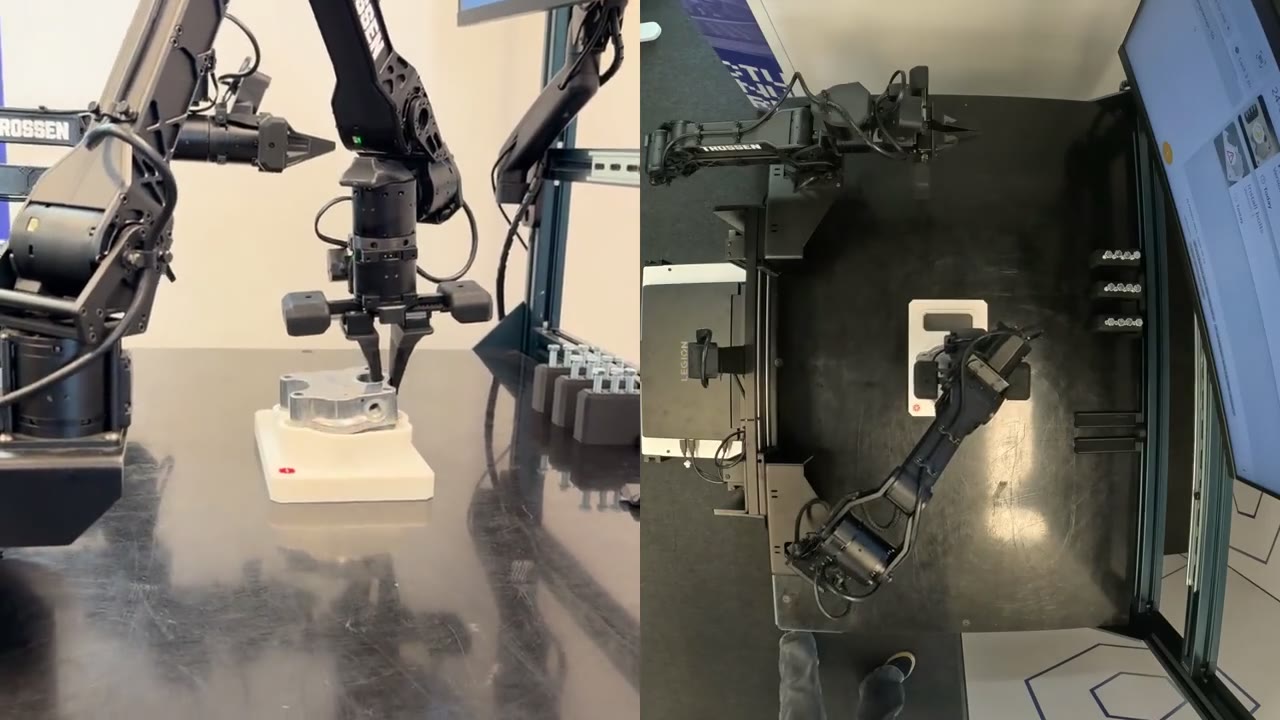
Azumuta's first robotics field note
A Trossen WidowX handled one component on the bench. An operator checked the result in Azumuta. When is the job finished?
Research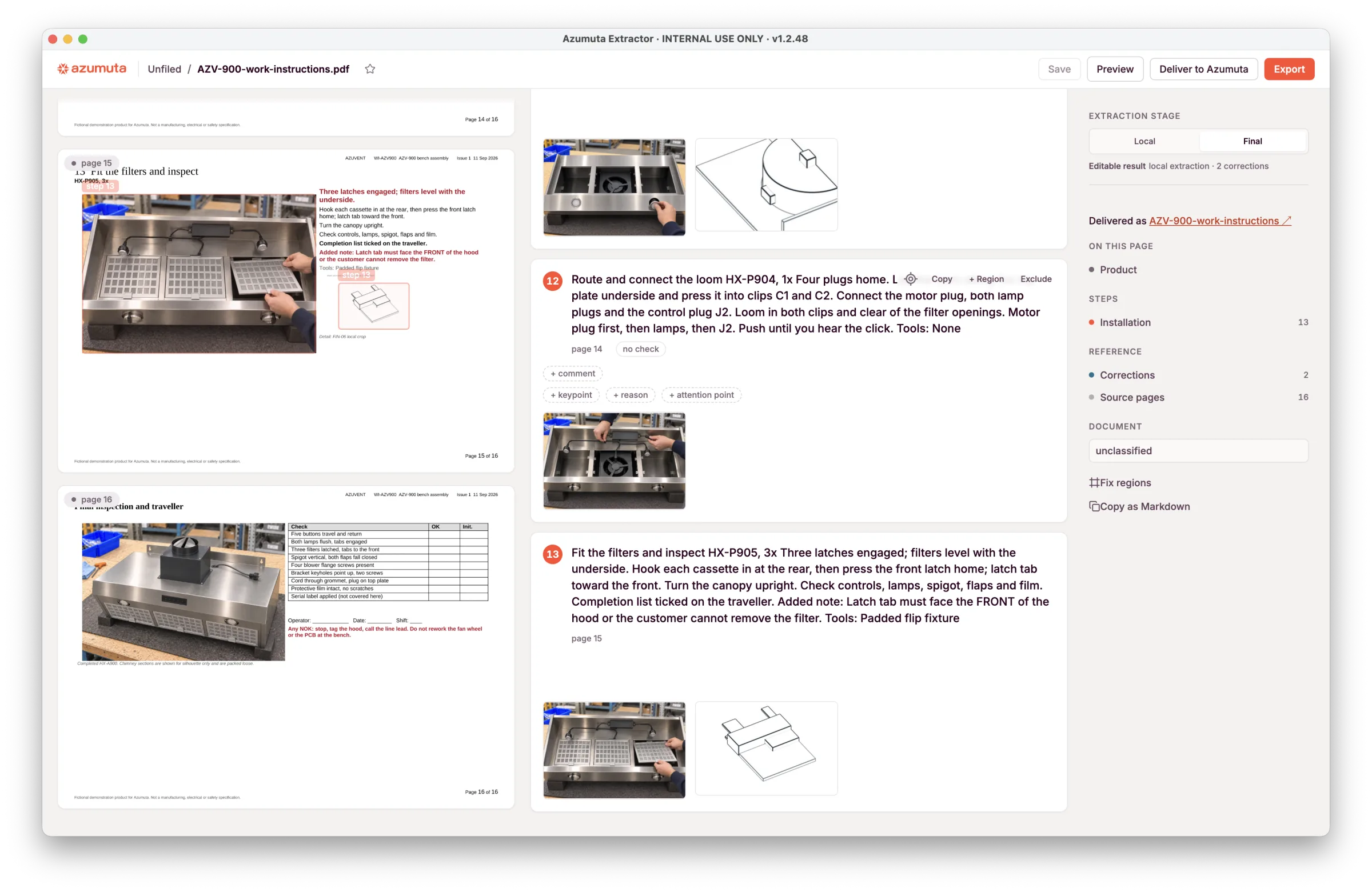
From static documents to reviewable work instructions
Azumuta's Document Extractor converts existing manufacturing documents into structured work instructions, with local and AI-assisted processing options.
Research
Introducing Azumuta Labs
A new public arm of Azumuta where we connect state-of-the-art manufacturing AI to real shop-floor problems, and share what we learn, including the failures.
AnnouncementBring a real challenge.
A process, document, or workstation that needs closer study. Work with our team to test a clear question and learn from the result.
Collaborate with us ↗