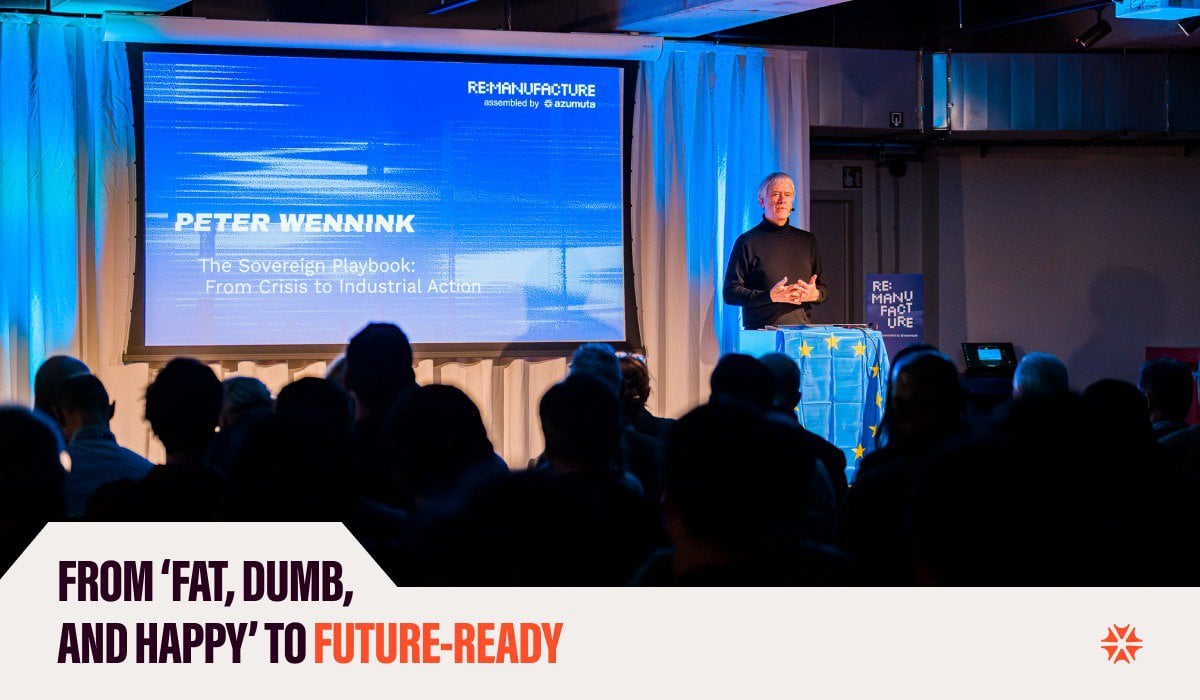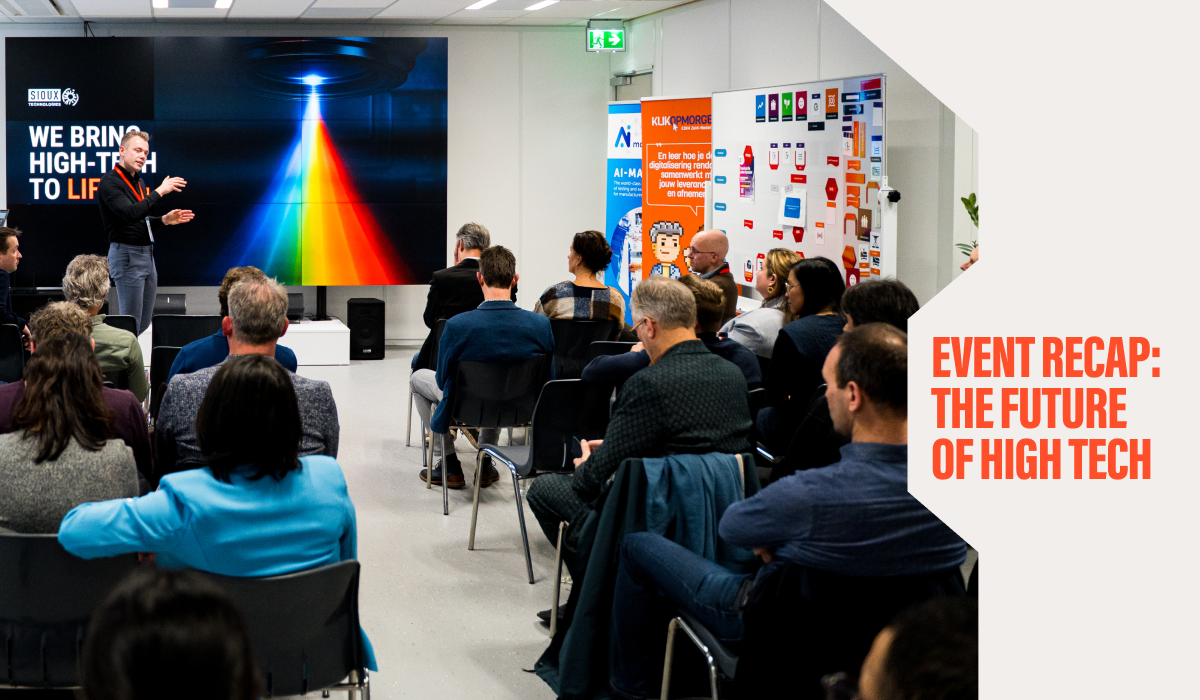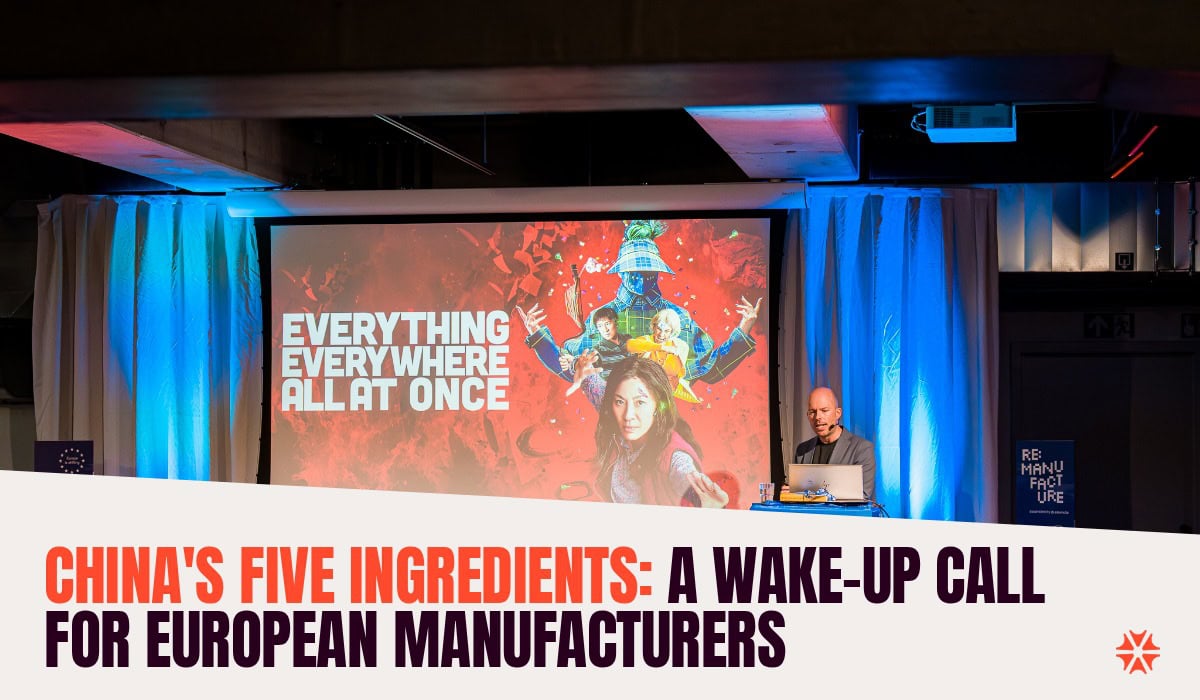
On March 17, 2026, Azumuta brought together some of Europe’s brightest minds in the manufacturing industry at the Wintercircus in Ghent, Belgium. During Re:Manufacture, these minds shared their vision on the future of manufacturing, and how we can face the challenges coming straight at us.
One of these bright minds was Tom Van de Weghe. As a correspondent for the Belgian national news station, he spent years reporting from inside China. He’s a journalist and researcher, not a consultant, which gives his observations a raw, eyewitness quality that boardroom briefings rarely deliver. He lived and breathed the way China operates, reporting the facts as they are, and even getting threatened and beat up for it during his tenure. When he took the stage at Re:Manufacture, fresh from a week in Beijing, what he said should make every European manufacturer uncomfortable.
Before Van de Weghe gets into the evidence of China’s undeniable growth, he names the five myths he hears from European executives constantly: that China competes on price, not quality; that China copies but doesn’t create; that China’s growth has already peaked; that Chinese industry is just subsidies; and that the US is ahead in AI. For Van de Weghe, believing these myths leads directly to bad strategy.
The “peak China” narrative is wrong
The dominant story in many European boardrooms is that China is structurally weakening. The property crash, the collapsed developers, the export restrictions. It sounds like a system under serious strain, and Van de Weghe understands why that story is appealing. It’s also wrong.
Yes, China’s property sector collapsed. Yes, major developers went under. But while Western analysts focused on those headlines, BYD kept growing at 28% per year. DeepSeek, built on a modest budget with restricted access to Western chips, matched the best Western AI models and wiped $600 billion from Meta’s market cap in a single day. Huawei, cut off from advanced semiconductors in 2020, released a competitive chip three years later. Restrictions didn’t stop them. They forced engineers to innovate differently, with smarter algorithms instead of brute-force computing power. China is now filing 1.8 million patents a year. The peak China story isn’t just wrong. It’s the kind of comfortable myth that, when built into strategy, quietly destroys companies.
“Misunderstanding China breeds complacency. And complacency at China’s speed is the biggest mistake you can make.” – Tom Van de Weghe
China’s 5 ingredients for industrial dominance
Van de Weghe’s framework for understanding what’s actually happening centers on five structural forces. Each is formidable on its own. Together, they explain why Western observers keep getting surprised.
1. Ecosystem first, companies second
China doesn’t simply pick winners and subsidize them. The state builds the playing field before companies move in: research institutes, industrial parks, universities, digital infrastructure. Van de Weghe saw this clearly during his visit to the Xiaomi EV factory in Beijing last week. The surrounding district already contains hundreds of robotics companies and thousands of biotech firms. Local governments compete intensely to build the best industrial zones, and innovation has become a competitive sport between cities, funded by hundreds of billions in patient, state-backed capital that can afford to wait in ways private markets cannot.
2. Speed that makes modern timelines look broken
In China, the lab and the factory are often next door to each other. A Chinese electric vehicle can be developed in as little as 18 months. In Europe, the same process typically takes four to five years. That’s not a cultural quirk. It’s a structural competitive advantage built into the supply chain and the decision cycle.
3. Hyper-competition as a selection mechanism
China’s tech sector is not centrally controlled, it is brutally competitive. At one point, more than 200 EV brands were fighting for the same domestic market. In artificial intelligence, the number of active models grew from 14 to over 500 in two years. Prices collapse, margins disappear, and the companies that survive are not fragile startups. When they come knocking on European doors, they arrive with price, speed, and quality at the same time.
“When these companies come knocking on our European doors, they’re not fragile startups anymore. They are war-tested competitors who already survived a bloodbath.” – Tom Van de Weghe
4. Scale that drives price down everywhere
With 1.4 billion consumers, China’s domestic market isn’t just demand. It’s a cost advantage that drives production volumes to levels that force prices down dramatically. Chinese consumers are also extraordinarily demanding: constant appetite for new features, very little brand loyalty, rapid product cycles. If your product is boring on Tuesday, Van de Weghe says, you might be dead by Friday. The pressure produces companies that are genuinely competitive everywhere else in the world by the time they leave China’s borders.
5. Education wired directly to industrial strategy
In a single year, China added over 1,600 new university programs aligned with current industrial priorities and removed almost the same number. Curricula evolve to match the industries that will dominate five years from now: AI, drones, green energy, robotics. Tens of millions of workers are being retrained simultaneously. Not as a social program, but as an industrial strategy.

Physical AI: the humanoid robot is coming to your factory floor
When all of those five ingredients work together, the result is what Chinese engineers call physical AI. Embodied intelligence entering the physical world. In one Beijing factory Van de Weghe visited, 700 robots work alongside roughly 100 human workers, producing a car every 76 seconds. A handful of engineers run the entire floor. This is the direction manufacturing is heading: not robots as tools, but robots as operators, increasingly in humanoid form.
Humanoid robots are following the same trajectory as solar panels and electric vehicles before them. Rapid scaling, collapsing prices, broad deployment. Last year, around 16,000 humanoid robots shipped globally, and the vast majority were Chinese. Some models now cost less than a small car. At China’s Spring Festival Gala, watched by over a billion people, humanoid robots performed martial arts and choreographed routines on stage alongside human performers. Last month, Van de Weghe walked through a robot shopping mall in Beijing where families bring their children to test drive humanoid machines.
Three things worth doing
Northvolt, the Swedish battery manufacturer once said to be Europe’s answer to Chinese battery dominance, raised billions and still couldn’t reach scale. Not because the money ran out, but because the ecosystem wasn’t there. As Peter Wennink argued in his Re:Manufacture talk, you cannot buy an innovation ecosystem. It requires supply chains, talent, infrastructure, and competition built over years.
Meanwhile, European dependency quietly grows. In Belgium alone, China became the largest non-EU supplier, with 32 billion euros in imports. This is no longer geopolitics on a conference screen. It’s already your reality.
It’s not all bad news though. Van de Weghe is not a China booster, and he’s not arguing that Europe is finished. He spent five years reporting from inside China, was beaten up for telling stories the government didn’t want told, and knows the system’s dark sides as well as its strengths. His point is precisely that misunderstanding China is the real danger. He believes there are three concrete things worth doing now:
- Understand the real system, not the caricature. Go to Shenzhen. Send your people there. Follow Chinese tech media directly rather than relying on Western summaries of it. A strategy still built on “peak China” myths is a strategy built on sand. How fast are your Chinese competitors releasing new product iterations? How many of your critical components have a single Chinese source with no viable alternative? Which companies in your segment are already preparing to enter Europe? Answering those questions honestly is what understanding the system actually means for an operations director.
- De-risk strategically. You cannot wall out the world’s largest manufacturer, but you choose how to engage with it. Map your exposure and prioritize reducing it where it matters most. That means auditing your supply chain by Chinese dependency, identifying which inputs have no realistic alternative supplier, and building redundancy there first. Strategic de-risking is about knowing which dominoes fall first, not about decoupling wholesale.
- Learn from the secret sauce. Build ecosystems before policies, collapse the distance between your lab and your factory floor, and connect education to industrial strategy in ways Europe currently doesn’t. In China, the lab and the factory are next door to each other. A design change made on Monday reaches production by Wednesday. In most European plants, that same change has to be documented, reviewed, printed, distributed, and retrained before it reaches the floor, a process that often takes weeks. That gap between engineering decision and operator execution is one of the most measurable speed disadvantages European manufacturers have.
Trust is Europe’s biggest advantage
When in Beijing, Van de Weghe asked a young AI engineer how she views the competition with Europe. She laughed. “We don’t really think about Europe.” But when he raised trustworthy AI, she paused. “If you build AI that people can trust,” she said, “that could really matter.”
GDPR, the AI Act or European data standards are easy to apologise for when competing on price and speed. Van de Weghe’s message is simple: stop apologizing and start selling them. As AI enters factories, supply chains, and eventually homes, the question of who controls the data and who is accountable will matter more and more. China will deliver the hardware. The AI layer running inside those systems is a race Europe can still run.
Not on scale, not on speed, but on trust. It’s the one opening China cannot close by building another factory or training another million engineers. Europe should stop treating it as a consolation prize and start treating it as a strategy.