
Multi Person Approval: How to Edit an Approval Flow
See create an approval flow for background. This article explains how to edit it or delete it.
Note: Currently, there are 2 templates for approval boards and approval flows: single-wave approval and dual-wave approval. Both templates share the same editing settings. The examples in this article use the dual-wave approval template. See both approval flow templates for more details.
To reach any approval flow action: go to Continuous Improvement → Settings in the side panel, then click the ⋮ (three-dot) icon next to the flow.
Get to the approval flow editor
From the ⋮ menu, click Edit flow.
The editor has five tabs: General, Flow Template, Advanced, Docx Reports, and Parameters. Each is covered below.
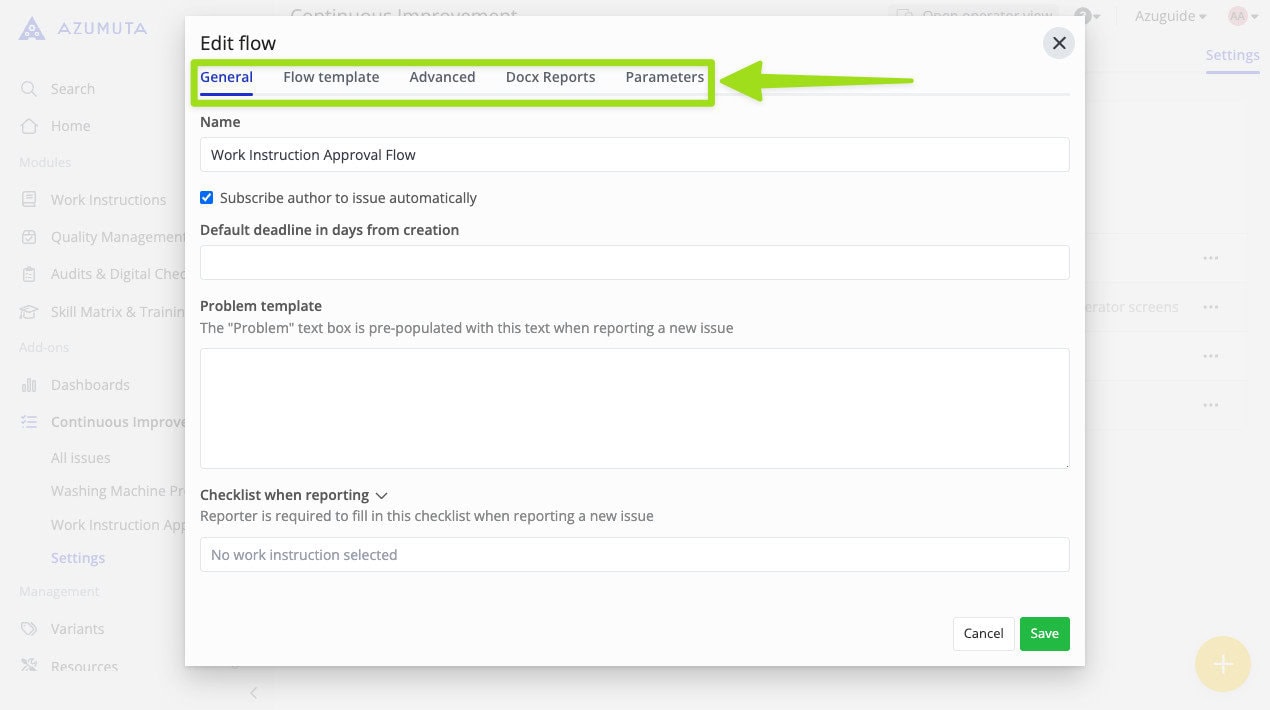
The General tab
The General tab opens first. Here is what you can edit:
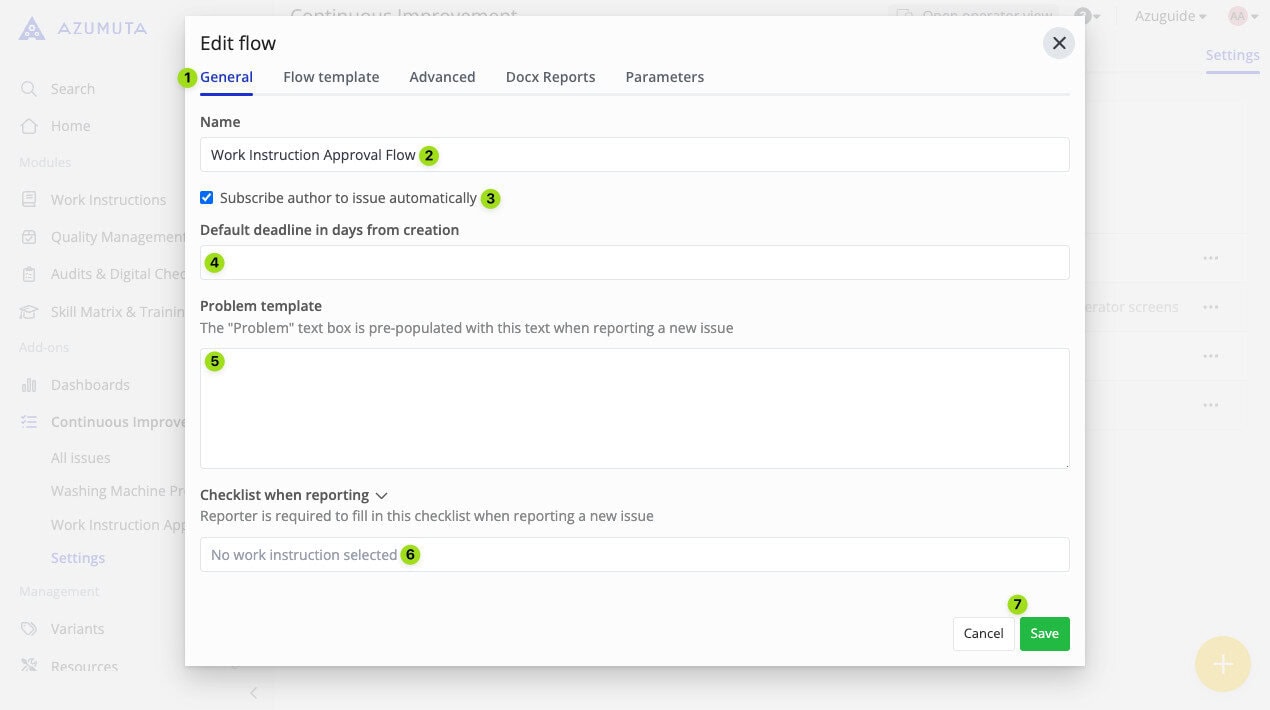
- Click to open the General tab.
- You can edit the approval flow’s name here.
- Select whether the user who submits an approval request is automatically subscribed to that approval request. If that person is subscribed, then that person will receive an email notification whenever that approval request changes columns.
- Insert the maximum number of days granted to approve an approval request that is listed on this approval flow (if needed).
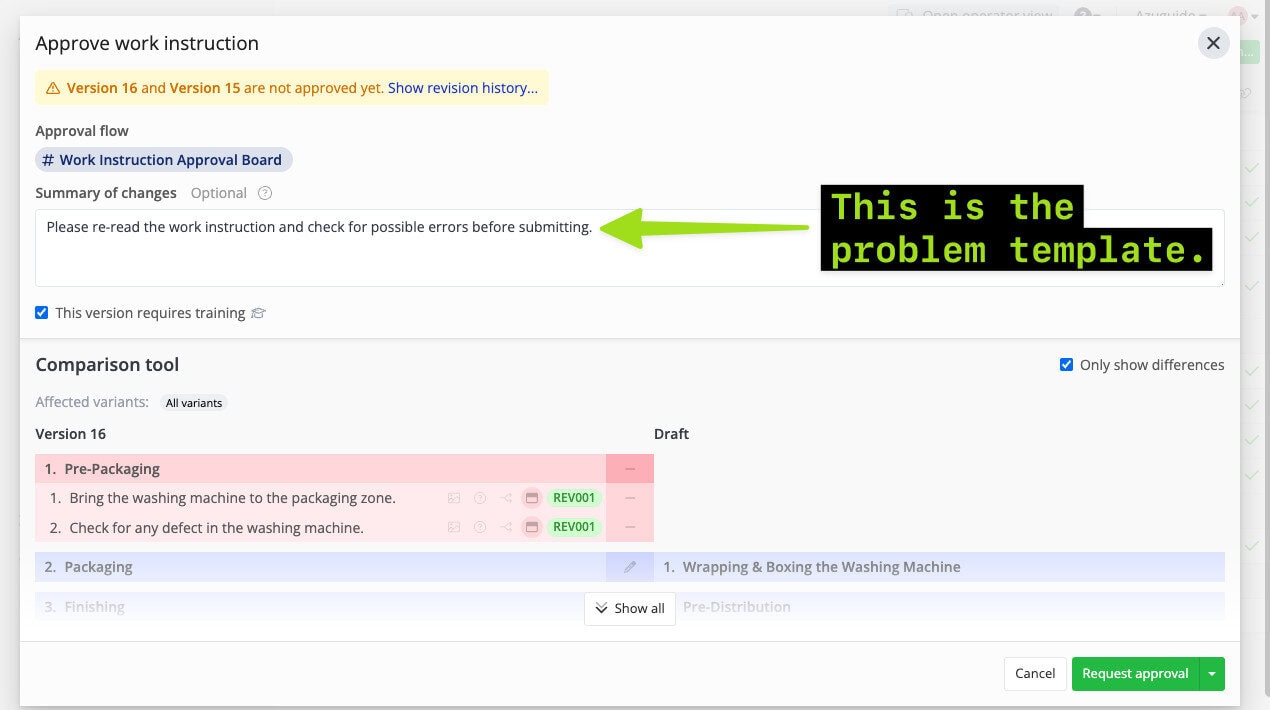
- Insert the problem template (if needed). A problem template is a text that will appear on a work instruction’s approval menu (as shown in the image below). A problem template is generally used to give a certain message to users who create or update work instructions.
- Insert a checklist (if needed). A checklist in an approval request works the same way a checklist in a ticket. See how to add a checklist to a ticket for more details.
- Click Save, or Cancel to discard your changes.
The Flow Template Tab
This is where the word “flow” in “approval flow” is derived from. An approval flow consists of several columns. A column represents an action step that needs to be taken in order to approve a work instruction.
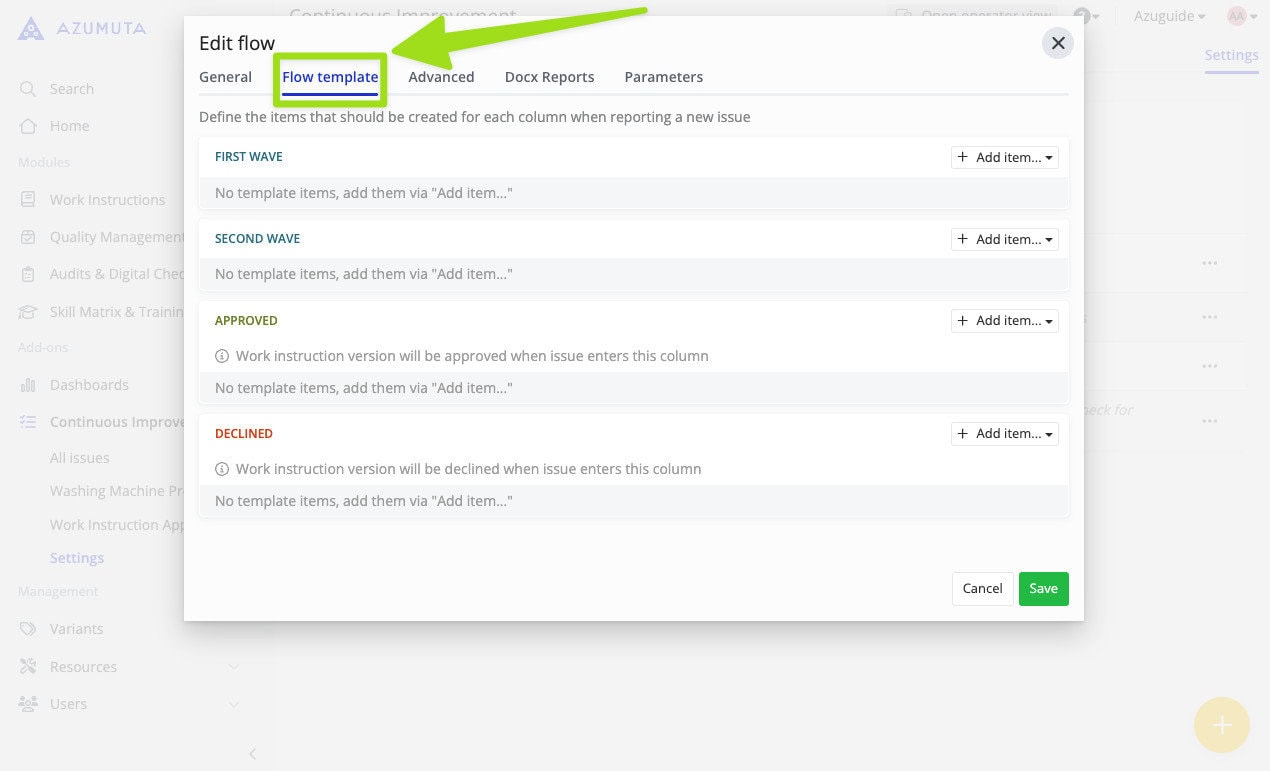
The existing columns will vary depending on the approvement flow template that you’re using. For example, within the dual-wave approval template there are 4 columns, which are:
- First Wave
- Second Wave
- Approved
- Declined
See how to edit a column’s name on the approval board.
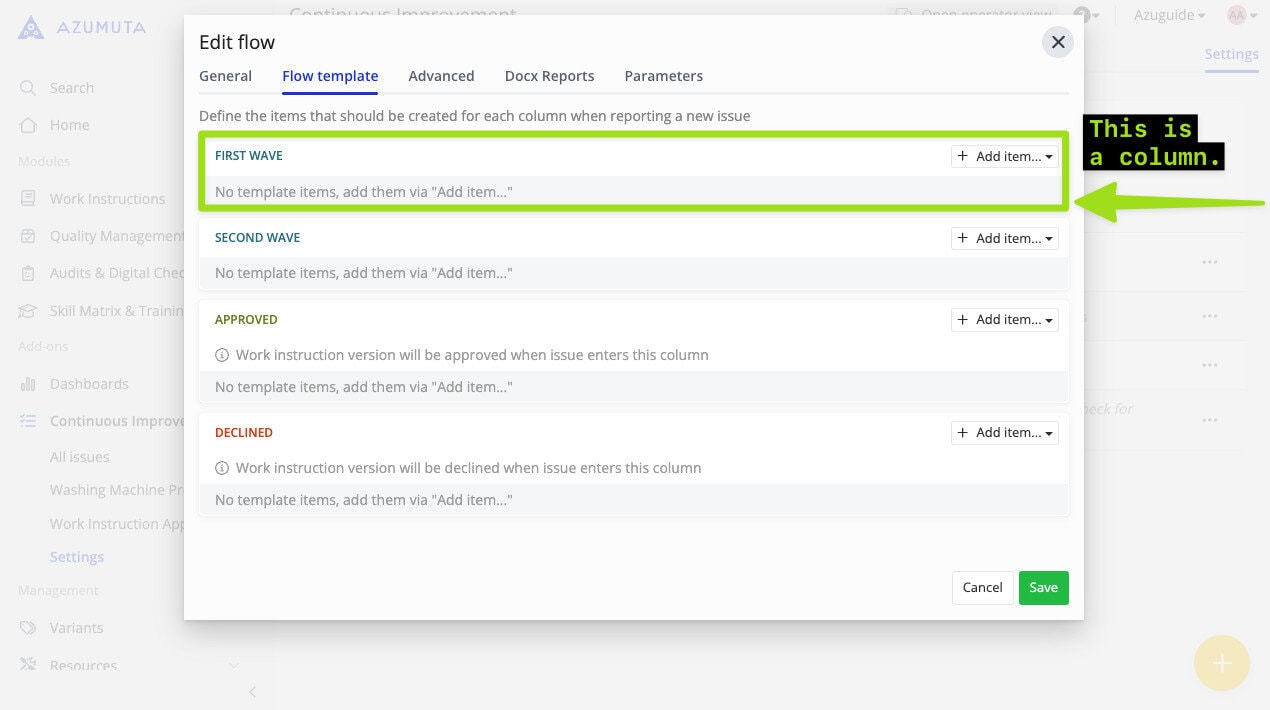
You can add multiple items for each column. We will explain how to add an item and how to edit it in the next sections.
Add an item to a column
To add an item to a column:
- Click Add Item in the target column.
- Select the item.
- Enter the details.
- Click Save.
Here are the available item options for each column:
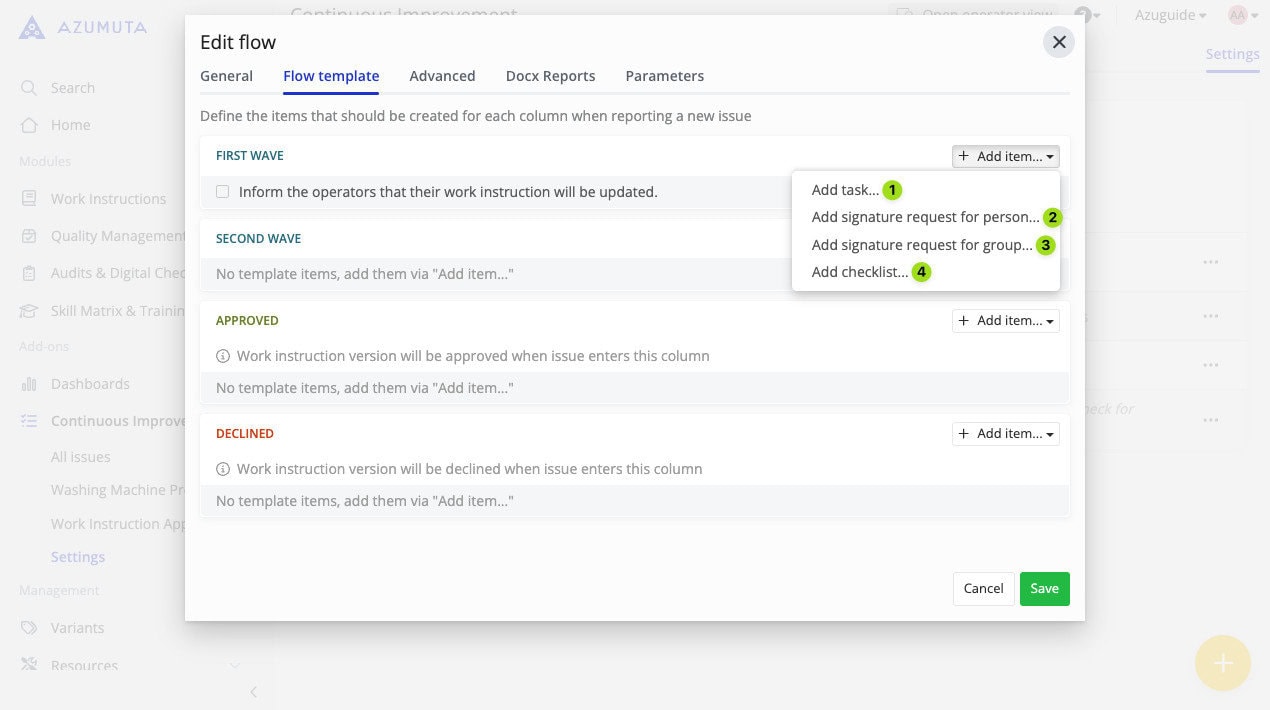
- Click to add a task. You can type the task’s description directly. Choose this item type if the item doesn’t need a signature or a checklist.
- Click to add a signature request for a specific person. A signature signifies that an operator has completed all the required items within a column and is ready to move to the next column, usually requested from a supervisor or a manager.
- Click to add a signature request to a user group.
- Click to add a checklist (a checklist in an approval request works the same way a checklist in a ticket).
Edit an item in a column
To edit an item:
- Click the ⋮ (three-dot) icon next to the item.
- Make your edits.
- Click Save.
The options differ by item type, as shown below.
Editing a Task
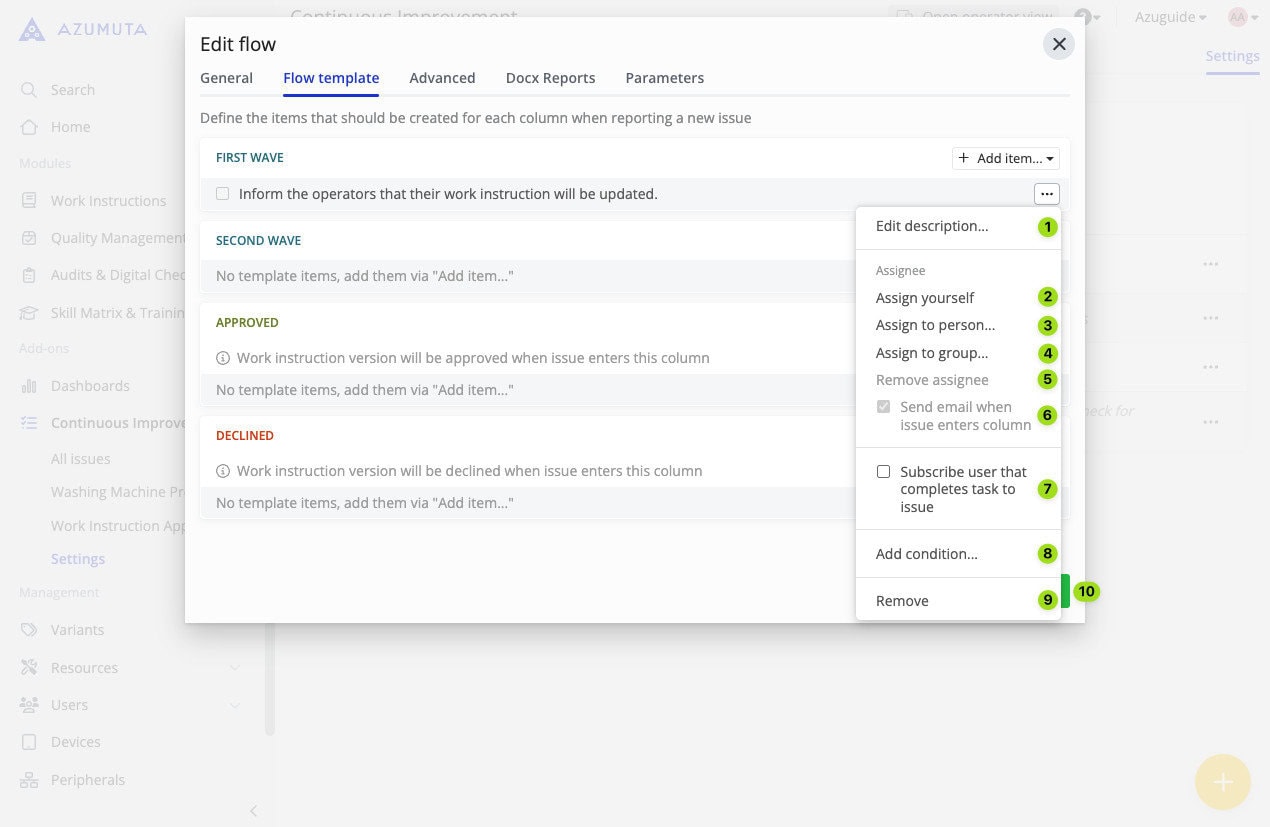
- Edit the task’s description here.
- Click to assign the task to yourself.
- Click to assign the task to a specific person.
- Click to assign the task to a specific user group.
- Click to remove the assigned person/user group (this can only be done if there’s already a person/user group that has been assigned).
- Select whether you want the assigned person/user group to receive an automated email from Azumuta that informs them when an approval request eaches this column.
- Select whether the person/user group that completes this task will be subscribed to the linked approval request. If someone is subscribed to an approval request, then that person will receive an automated email notification whenever that approval request changes status.
- Click to add a condition. With this feature, the task will be automatically created if the approval request involves updating instruction steps that contain one of the selected symbols.
- Click to remove the task.
- Click Save, or Cancel to discard your changes.
Editing a Signature Request to a Person/to a User Group
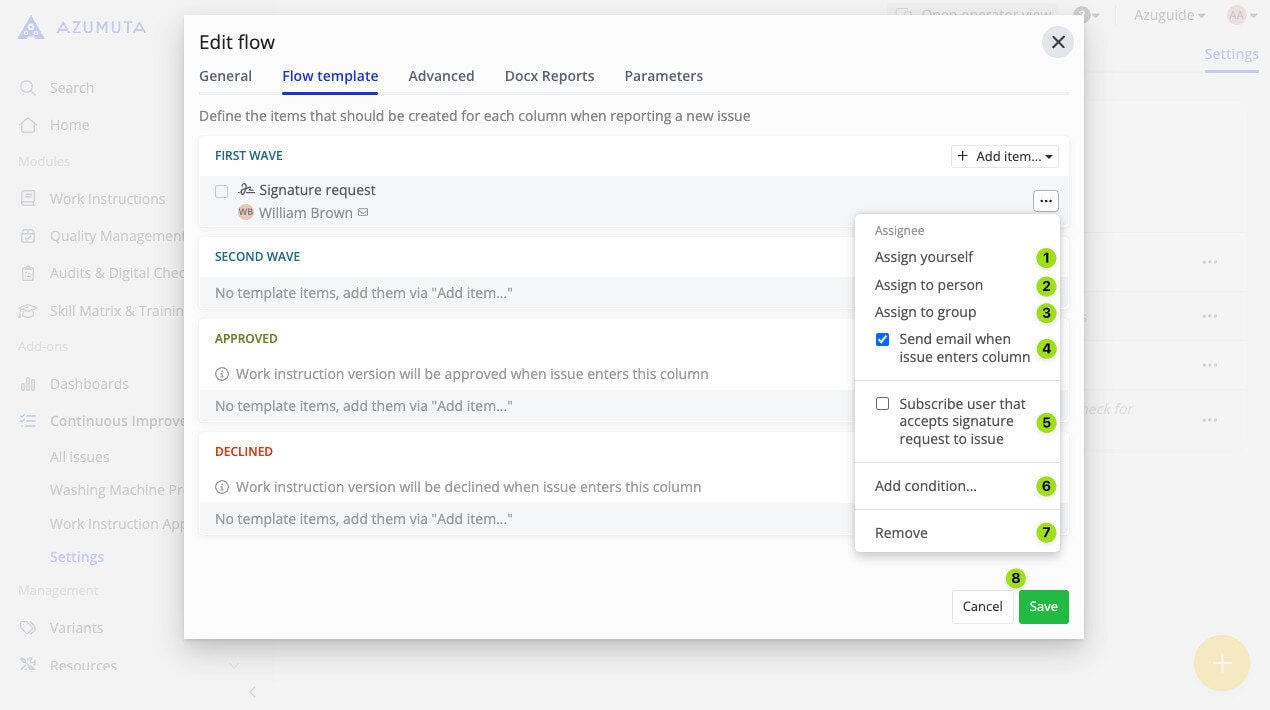
- If you choose this option, then you’re the only person authorized to sign this signature request.
- Select the person who’s authorized to sign this signature request
- Select the user group that’s authorized to sign this signature request.
- Select whether you want the assigned person/user group to receive an automated email from Azumuta that informs them when an approval request reaches this column.
- Select whether the person/user group that gave a signature to be subscribed to the linked approval request. If someone is subscribed to an approval request, then that person will receive an automated email notification whenever that approval request changes status.
- Click to add a condition. With this feature, the signature request will be automatically created if the approval request involves updating instruction steps that contain one of the selected symbols.
- Click to remove the signature request.
- Click Save, or Cancel to discard your changes.
Editing a Checklist
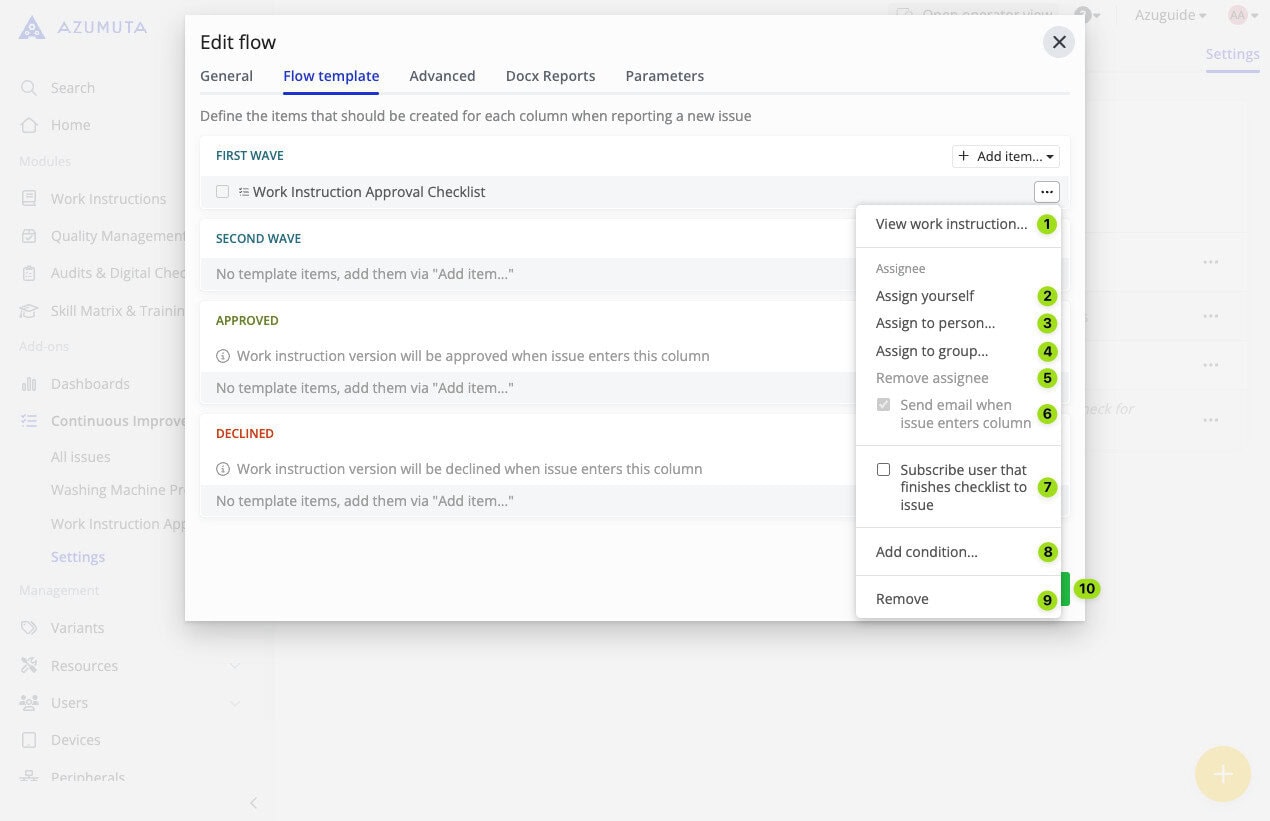
- Click to view the checklist work instruction. A checklist in an approval request works the same way a checklist in a ticket. See how to add a checklist to a ticket for more details.
- Click to assign the checklist to yourself.
- Click to assign a specific person to fill out the checklist.
- Click to assign a user group to fill out the checklist.
- Click to remove the assigned person/user group (this can only be done if there’s already a person/user group that has been assigned).
- Select whether you want the assigned person/user group to receive an automated email from Azumuta that informs them when an approval request reaches this column.
- Select whether the person/user group that fills out the checklist will be subscribed to the linked approval request. If someone is subscribed to an approval request, then that person will receive an automated email notification whenever that approval request changes status.
- Click to add a condition. With this feature, the checklist will be automatically added if the approval request involves updating instruction steps that contain one of the selected symbols.
- Click to remove the checklist.
- Click Save, or Cancel to discard your changes.
The Advanced Tab
The Advanced tab consists of 2 elements: columns and transitions. In the Advanced tab, a column represents an action step that needs to be taken in order to approve a work instruction, just like in the Flow Template tab.
The column names will vary depending on the approval flow template that you’re using. For example, within the dual-wave approval template, there are 4 columns, which are:
- First Wave
- Second Wave
- Approved
- Declined
Meanwhile, a transition functions as a bridge between columns. A transition leads an item to another column, based on a pre-configured scenario.
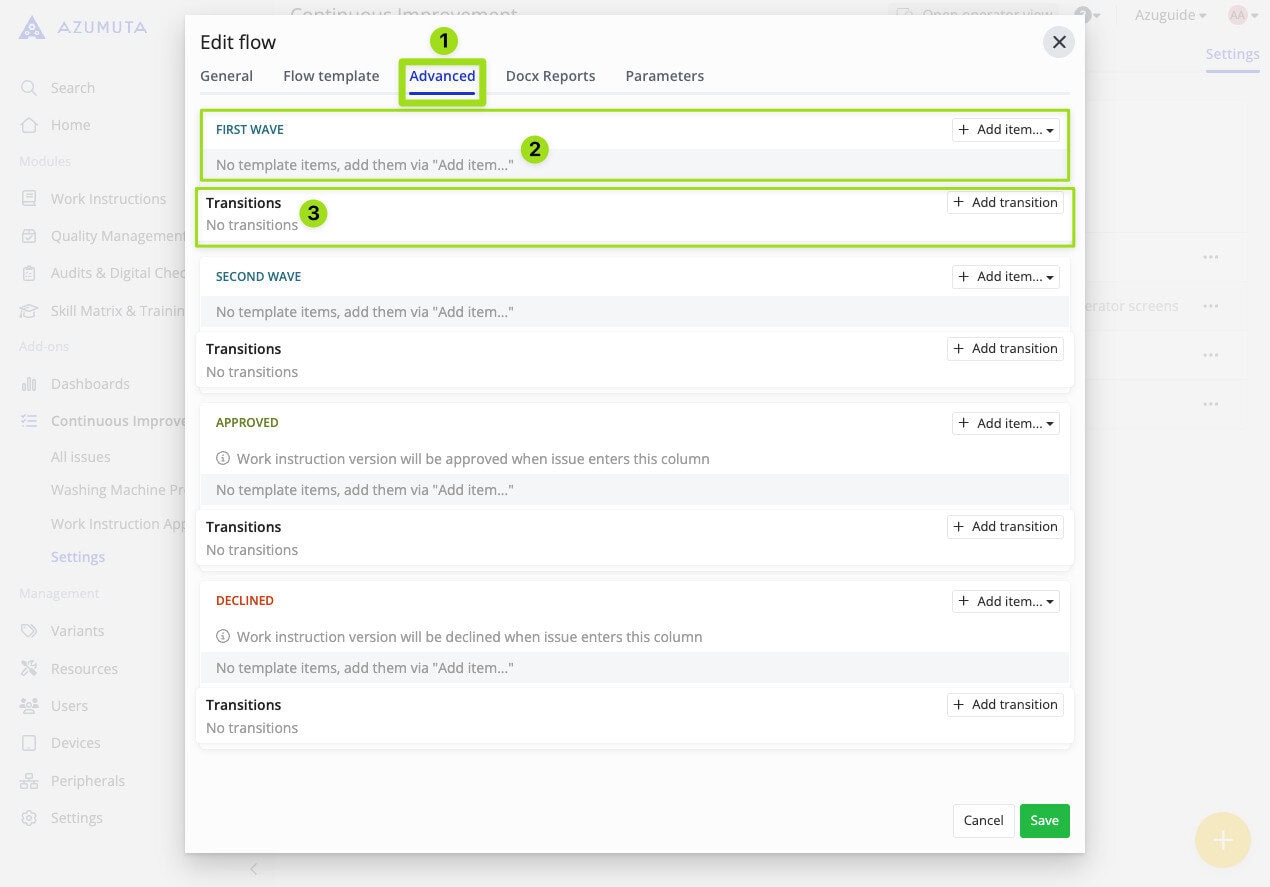
- Click to open the Advanced tab.
- This is a column.
- This is the list of transitions for this column.
Add an item to a column (Advanced tab)
To add an item to a column:
- Click Add Item in the target column.
- Select the item.
- Enter the details.
- Click Save.
Note: If you added an item on the Flow Template tab, then that item will also appear in the same column on the Advanced tab. And conversely, if you added an item on the Advanced tab, then it will also appear on the same column on the Flow Template tab.
Here are the available item options for each column:
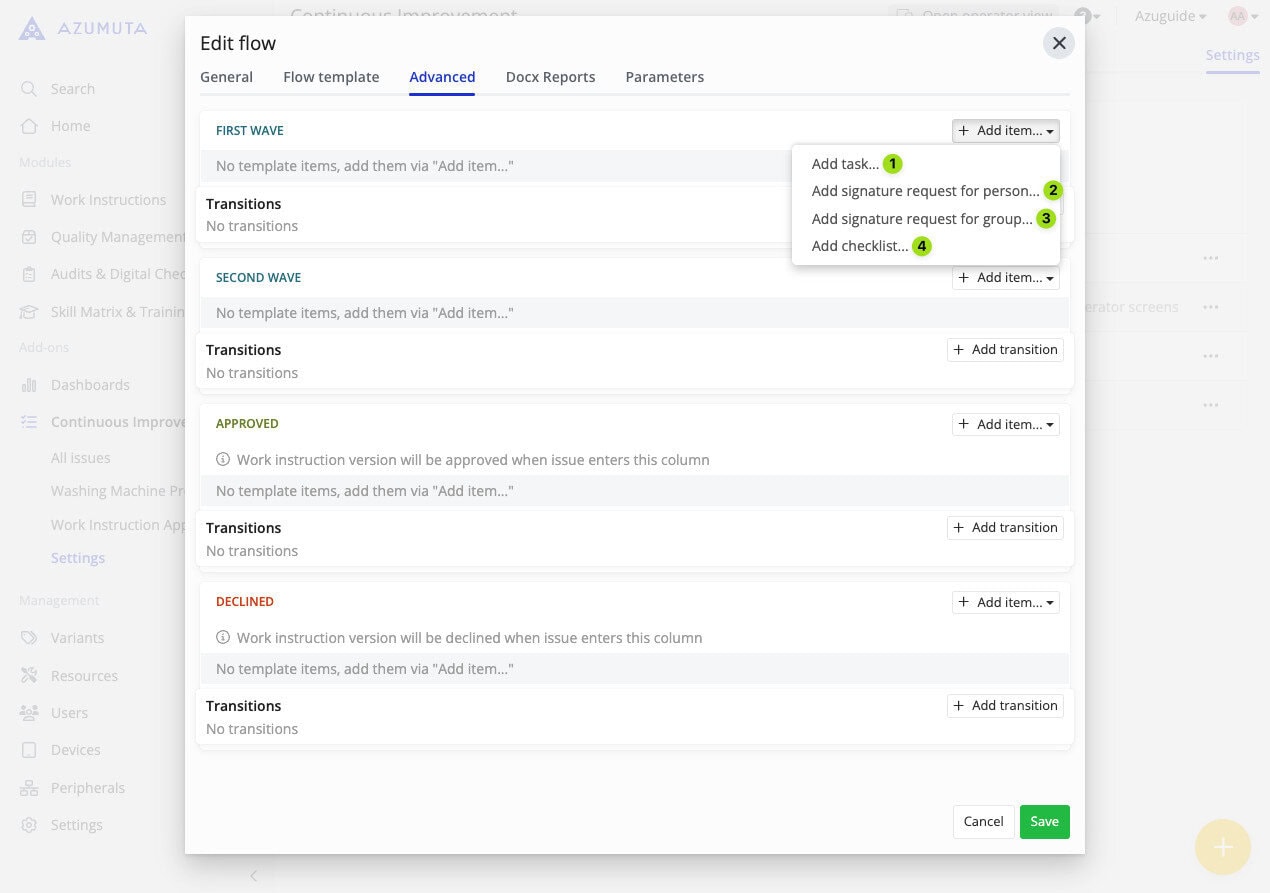
- Click to add a task. You can type the task’s description directly. Choose this item type if the item doesn’t need a signature or a checklist.
- Click to add a signature request for a specific person. A signature signifies that an operator has completed all the required items within a column and is ready to move to the next column, usually requested from a supervisor or a manager.
- Click to add a signature request to a user group.
- Click to add a checklist. A checklist in an approval request works the same way a checklist in a ticket. See how to add a checklist to a ticket for more details.
Edit an item in a column (Advanced tab)
Editing an item on a column in this tab works the same way as in the Flow Template Tab. Check out the links below to see how you can edit an item on a column based on the item type:
- How to Edit a Task
- How to Edit a Signature Request to a Person/to a User Group
- How to Edit a Checklist
Note: If you edited an item on the Flow Template tab, then that item will also be automatically updated on the Advanced tab. And conversely, if you edited an item on the Advanced tab, then the same item will also be automatically updated on the Flow Template tab.
Add a transition
- Click Add transition on the target column.
- Select an option from the When dropdown.
- Select an option from the Then move to dropdown.
- Click Save.
The When and Then Move to dropdown menus have a cause-and-effect relationship.
Whenever the event in the When dropdown menu happens, then it will cause the event in the Then Move to dropdown menu to occur.
Edit a transition
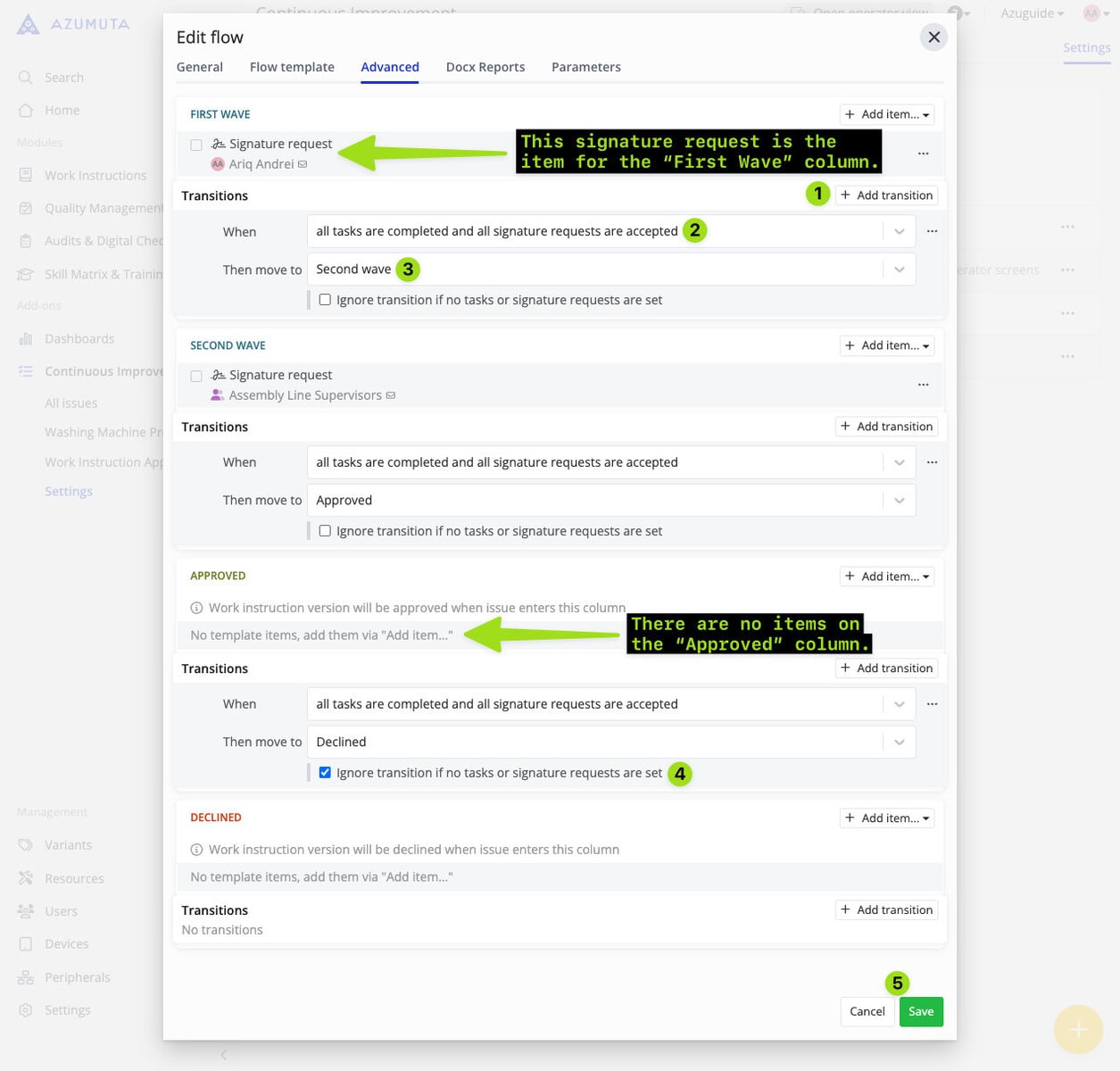
- To add an additional transition to this column, click Add transition.
- Click to change the content on the When dropdown menu.
- Click to change the content on the Then move to dropdown menu.
- In Azumuta, all approval requests will automatically proceed to the next column if there are no outstanding items remaining (be it because all items in this column have been completed or no items were added to this column in the first place). If you want to prevent an approval flow from automatically proceeding to the next column because no items were added to this column, then tick this option.
- Click Save, or Cancel to discard your changes.
The Docx Reports Tab
You can add Docx reports to an approval flow. See docx reporting with ticket information for more details (it works the same way as docx reporting for tickets).
The Parameters Tab
You can add parameters to an approval flow. These parameters will be listed on all approval requests that fall under this approval flow’s umbrella, as well as on all checklists that are linked to those approval flows.
Add a parameter to an approval flow
- Click Add field.
- Enter the parameter's Key and Value.
- Click Save.
Edit a parameter on an approval flow
Edit the parameter's Key or Value, then click Save.
Delete a parameter on an approval flow
- Click the parameter you want to delete.
- Click the trash can icon.
- Click Save.
Delete an approval flow
- From the ⋮ menu
- Click Delete flow
- Confirm with Delete.